
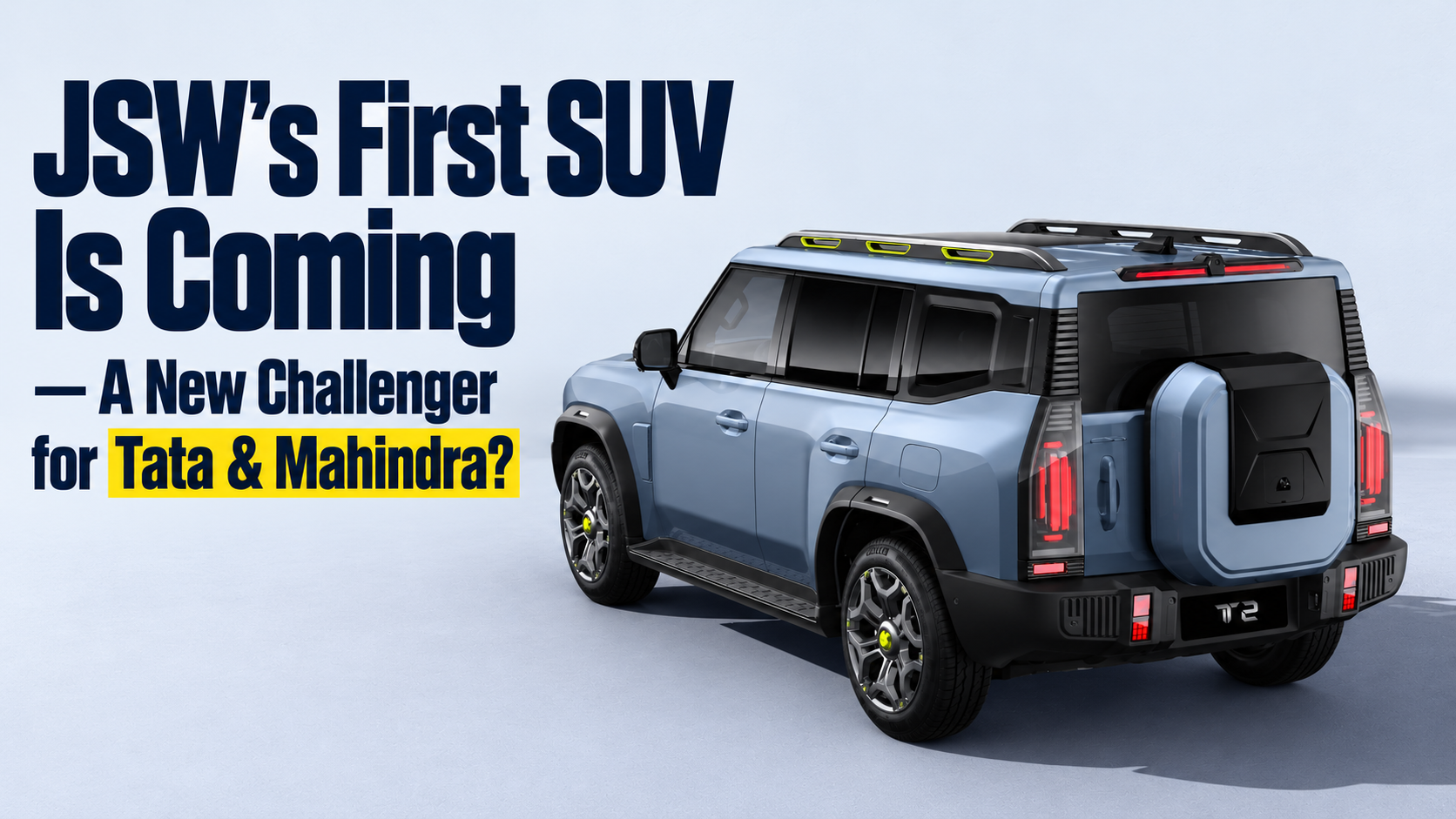
JSW first SUV: A comprehensive guide to the launch reports and your buying decision
Updated: 11 October 2026
Summarise this blog post with: ChatGPT | Perplexity | Claude | Grok
If you’re shortlisting an Indian SUV, Tata and Mahindra are probably already on your list. The JSW first SUV adds another possibility, but conflicting launch reports and its connection with MG make the headlines confusing. In this guide, we’ll explain the evidence, the reported hybrid technology, and the ownership questions worth asking.
Key Takeaways
- JSW Motors’ own-brand programme is separate from the JSW MG Motor India joint venture, according to Autocar India.
- JSW’s first model is reported to be a Jetour T2-based plug-in hybrid SUV.
- Combat and 4 December 2026 are reported name and launch-date claims, pending independent verification through a company announcement.
- Regular charging helps a plug-in hybrid replace more petrol-powered kilometres with electric driving.
- Meaningful comparisons match specific variants, budgets, seating requirements, and intended use.
- Booking decisions should follow verified Indian specifications, prices, warranty terms, and service arrangements.
What Is JSW Motors’ First SUV for India?
JSW Motors’ first model is a planned Jetour T2-based plug-in hybrid SUV, according to Autocar India. The proposed product could appeal to buyers seeking electric commuting with petrol-powered flexibility for longer journeys.
First, Indian ownership, vehicle engineering, and manufacturing location describe different things. An Indian company can sell a vehicle using an overseas platform while assembling it locally; that does not mean the vehicle was entirely developed in India.
Similarly, platform sharing means using common engineering foundations across products. Localisation means sourcing or producing components domestically—for example, seats or body panels—rather than importing everything.
JSW Motors’ first own-brand SUV is planned independently of the JSW MG Motor India joint venture, according to Autocar India. Buyers should therefore request explicit confirmation before assuming an MG workshop will service a JSW-branded vehicle.
[Internal link: https://turbobehind.com/honda-wireless-ev-charging-technology-a-comprehens/]
Why Does JSW’s SUV Entry Matter for Indian Buyers?
JSW’s SUV entry could broaden powertrain choices and give buyers another manufacturer to evaluate. For example, a plug-in hybrid could attract someone who can charge overnight but regularly travels beyond convenient charging routes.
Meanwhile, JSW describes an automotive investment commitment of up to US$3 billion over five years—Source: JSW Group, 2026. This concerns the broader mobility ecosystem, not spending exclusively on the first SUV. jsw.in
However, investment does not establish product quality or customer satisfaction. A competitively equipped vehicle still needs dependable repairs, available parts, and clear warranty decisions.
Ultimately, additional competition may encourage stronger products or ownership packages. Lower prices and market-share gains remain possibilities, not guaranteed outcomes.
What Are the JSW SUV’s Reported Name, Launch Date, and Price?
The JSW SUV’s name, launch schedule, and price remain reported details rather than a fully verified retail offer in the sources reviewed. Buyers should distinguish a publication’s estimate from a manufacturer’s dated announcement.
| Detail | Latest claim | Evidence status | Source/date |
|---|---|---|---|
| Name | JSW Combat | Reported; company confirmation not independently verified | Navbharat Times, 11 October 2026 |
| Launch | 4 December 2026 | Reported; conflicts with an earlier Diwali timeline | Navbharat Times, 11 October; Autocar listing checked 11 October |
| Price | ₹40–50 lakh estimate; Autocar lists ₹38–40 lakh elsewhere | Neither establishes an official price | Same sources, checked 11 October |
| Production location | Assembly at Chhatrapati Sambhajinagar | Model-specific assembly reported; broader facility supported by JSW | Navbharat Times; JSW corporate information |
| Bookings | Official amount, opening date, and refund terms not verified | Not yet verified | Source review, 11 October 2026 |
Crucially, conflicting estimates should not be averaged into a supposed launch price. The difference between the listings could materially change which vehicles belong on a buyer’s shortlist.
Likewise, a launch event, booking opening, and customer delivery date are separate milestones. An announced unveiling does not establish when your chosen variant will reach your driveway.
Is the JSW SUV a Plug-in Hybrid or a Fully Electric Vehicle?
The proposed JSW SUV is said to be a plug-in hybrid rather than a fully electric vehicle. The final battery size, ability to recharge, and official range in India remain to be seen.
A plug-in hybrid electric vehicle is a hybrid electric vehicle that can be charged by plugging in an external power source. The vehicle has both a prime internal combustion engine and an electric motor and battery. The vehicle can be powered by the electric motor with the battery charged by an external power source or by the prime internal combustion engine, or a combination of the two.
For instance, one could charge the battery overnight and drive the car around on electric power for a while before needing to run the engine to recharge the battery. The engine could also be used to supplement the electric motor, for example, when more power is needed.
It is crucial to charge it often, as a PHEV which is seldom plugged in cannot provide the same percentage of electric-only travel as one which regularly charges in between journeys.
[Internal link: https://turbobehind.com/mercedes-benz-global-sales-fall-6-india-sales/]
When comparing ranges, remember to separate electricity-only ranges from combined petrol-and-electric ranges. Report the relevant test cycle alongside any range figures, and never assume that overseas specifications apply to an Indian variant automatically.
Which Tata SUVs Could Buyers Compare With JSW?
Tata’s Harrier.ev provides an existing electric-SUV benchmark, although direct price overlap with JSW is not established. Its variants help buyers examine what an alternative electrified ownership package offers.
For reference, Tata announced the Harrier.ev Adventure 65 at ₹21.49 lakh and the Empowered 75 QWD at ₹28.99 lakh, ex-showroom. These are dated announcement prices, not guaranteed October 2026 quotations.
Meanwhile, Tata identifies 65 kWh and 75 kWh battery options. The Adventure and QWD variants serve different equipment and drivetrain priorities.
For families, the useful questions concern charging access, rear-seat comfort, luggage space, and the exact variant’s equipment. A fully electric vehicle requires a different long-distance energy plan from a PHEV.
[Internal link: https://turbobehind.com/best-family-suvs-in-india-for-a-budget-of-12-15l/]
Which Mahindra SUVs Could Buyers Compare With JSW?
Mahindra’s XEV 9e and selected Thar Roxx 4WD variants provide separate electric-driving and off-road benchmarks. They should not be treated as interchangeable alternatives.
For reference, Mahindra announced the XEV 9e Pack Two 59 kWh at ₹24.90 lakh and 79 kWh at ₹26.50 lakh, ex-showroom, excluding charger and installation. Obtain fresh quotations before comparing purchase costs.
Separately, the Thar Roxx AX7L diesel 4WD is a relevant capability benchmark. Mahindra’s brochure identifies a part-time four-wheel-drive system with high and low reduction gearing and an electronic locking differential on applicable versions.
Importantly, a buyer seeking electric commuting and a buyer needing low-range gearing have different requirements. The right comparison begins with the journey, not the badge.
[Internal link: https://turbobehind.com/scorpio-n-pickup-model-not-made-for-indian-buyers/]
How Can Buyers Compare JSW, Tata, and Mahindra SUVs?
To compare a new SUV launch with existing options, it is essential to distinguish between confirmed Indian specifications and reported or overseas specifications. The same five dimensions should be used to evaluate each shortlisted variant.
How could purchase prices be compared?
First, the on-road price is how much it will cost to put the chosen vehicle on the road. Registration, insurance and other charges should also be taken into account, because an ex-showroom headline cannot determine affordability.
For example, request quotations using the same city, insurance coverage and purchase date. Ask dealers to remove optional accessories, charger costs, installation and any discounts.
Next, there must be a comparison of the equipment that is actually needed. A cheaper variant without the desired number of seats and drivetrains cannot be considered because both vehicles carry an SUV badge.
The JSW purchase-price entry should still be “Not yet verified.” If the eventual pricing resembles current media estimates, several Tata and Mahindra variants would be more budget-friendly alternatives than direct competitors.
Finally, financing should be kept separate from the vehicle’s cash price. A record of total interest and fees should be made, instead of assessing the affordability with the help of the monthly instalment. A longer loan can reduce the instalment, but increase the overall expenditure.
How should powertrain and charging needs be compared?
First, powertrain suitability depends on how you drive and replenish energy. A home-charging commuter faces a different decision from someone relying entirely on public infrastructure.
For the reported JSW PHEV, request electric-only range, charging time, and fuel consumption after the usable electric range is depleted. A combined-range headline cannot answer those separate questions.
For the Harrier.ev and XEV 9e, examine charging compatibility, realistic route stops, and consumption with passengers and luggage. Compare the exact battery variant you can afford.
Similarly, investigate the parking arrangement before choosing any plug-in vehicle. Check whether electrical installation is feasible and whether the quoted charger package includes the work your property requires.
Finally, compare electricity and petrol costs separately for a PHEV. Record charging losses and public-charging expenses where relevant. Do not apply a battery vehicle’s electricity-only calculation to every kilometre driven by a hybrid.
How should space and family practicality be compared?
Firstly, family practicality is the ability to carry your passengers and possessions comfortably. This can’t be judged from the exterior measurements.
For example, bring a representative party of your regular passengers, child seat and typical luggage to all showrooms. Try entering the vehicle, sitting in, checking for vision out, using the rear controls and accessing your usual storage space.
The next consideration is seating configurations. A household looking for an additional row would not waste time studying the differences in acceleration and cosmetics if their existing family car doesn’t allow the seating of their extended family.
On a test drive, include broken roads, speed breakers and a parking exercise. The comfort of the rear seat passengers is as important as the driving seat.
For JSW, note down the unverified luggage capacity and Indian cabins. The shots taken overseas might show a different equipment level.
Finally, apply a single written checklist across all cars. A practical SUV comparison evaluates the experience of your own household and not the length of the feature list on paper.
How should safety and off-road capability be compared?
First, safety assessment requires applicable crash-test evidence and variant-specific equipment. Rugged styling does not establish crash protection or off-road ability.
For context, the Harrier.ev and XEV 9e each recorded 32/32 adult-occupant points in their published assessments. Check each assessment’s applicability to the vehicle being purchased. bncap
For JSW, an applicable Indian crash-test result was not verified for this article. An overseas result should not automatically be transferred to a differently specified Indian vehicle.
Separately, inspect drivetrain documentation. Multiple motors do not necessarily mean both axles receive propulsion, and four-wheel drive does not automatically include low-range gearing.
For demanding trails, assess tyres, clearance, gearing, recovery provisions, and independent testing. Match the evidence to the terrain you expect.
What should buyers check about warranty and service support?
To start with, ownership support refers to some warranty provisions, general repair accessibility, parts availability, and post-sale service. For example, even if there is a warranty claim coverage, the inconvenience of a delayed spare parts replacement still exists. Therefore, it is crucial to clarify all the details about service and repair terms and conditions before the purchase.
Specifically, a buyer should request a written warranty about the vehicle and battery from the manufacturer and look through the details about the exclusions, mileage restrictions, warranty transferability, and other capacity-related limitations. Moreover, it is obligatory to contact the workshop that will provide service and repair and find out if they support the chosen model and power train or not.
Therefore, in the case of JSW, it should ask the manufacturer to provide the list of authorised service providers and their escalation policy. In other words, the JSW should not assume that the affiliated group members offer the same service and repair options as those provided by JSW itself unless otherwise specified in the contract terms and conditions. In addition to that, the potential buyer should clarify the details about the standard service period, replacement tyres, typical spare parts, and road-side assistance. Moreover, similar issues should be raised to Tata and Mahindra.
To conclude, it is critical to note that for JSW, the most challenging part of this exercise will be to persuade potential buyers to choose its services after introducing its brand. In other words, the initial enthusiasm about the purchase may fade due to the lack of ownership evidence.
Should Buyers Wait for JSW or Buy an Available Alternative?
Waiting is reasonable when the reported product fits your needs and your purchase deadline allows unresolved details to become clear.
- Commuter with home charging: Consider waiting if a PHEV fits your daily use and longer journeys. Compare the final JSW offer against suitable battery-electric alternatives.
- Family needing an immediate purchase: Evaluate available vehicles with verified equipment, test drives, and written delivery commitments.
- Buyer requiring off-road capability: Prioritise documented hardware and independent testing, including relevant Thar Roxx 4WD versions. Leave JSW’s capability ungraded until evidence arrives.
[Internal link:https://turbobehind.com/mahindra-be6-formula-e-edition-price-specs-range/]
Which Tools Help Compare SUV Ownership Costs?
An SUV ownership-cost comparison involves adding purchase, energy, insurance, maintenance, and financing costs, then accounting for expected resale value over a defined period.
First, use a free spreadsheet or paper worksheet with identical assumptions for every vehicle. Enter your annual distance, local energy prices, written quotations, and conservative resale scenarios.
Next, use official brochures and dealer locators to verify equipment and workshop access. Save dated copies and confirm details directly.
What Should Buyers Check Before Booking JSW’s SUV?
Buyers should verify the Indian product and ownership terms before committing money.
- Obtain the official Indian specification sheet.
- Request the final variant-wise and on-road prices.
- Read booking, cancellation, and refund terms.
- Check vehicle and battery warranty documents.
- Confirm a nearby authorised workshop.
- Review independent safety and driving evidence.
- Get a written delivery estimate.
Conclusion: Could JSW Become a Credible Challenger?
JSW could become a credible challenger if its final product, price, and ownership experience meet buyers’ needs. Its reported PHEV approach could complement the available choices while competing for some of the same customers.
Ultimately, a wider shortlist gives buyers more choice—use verified information and a test drive to choose what fits your needs.
Written by: Sourav Ranjan, content writer.