
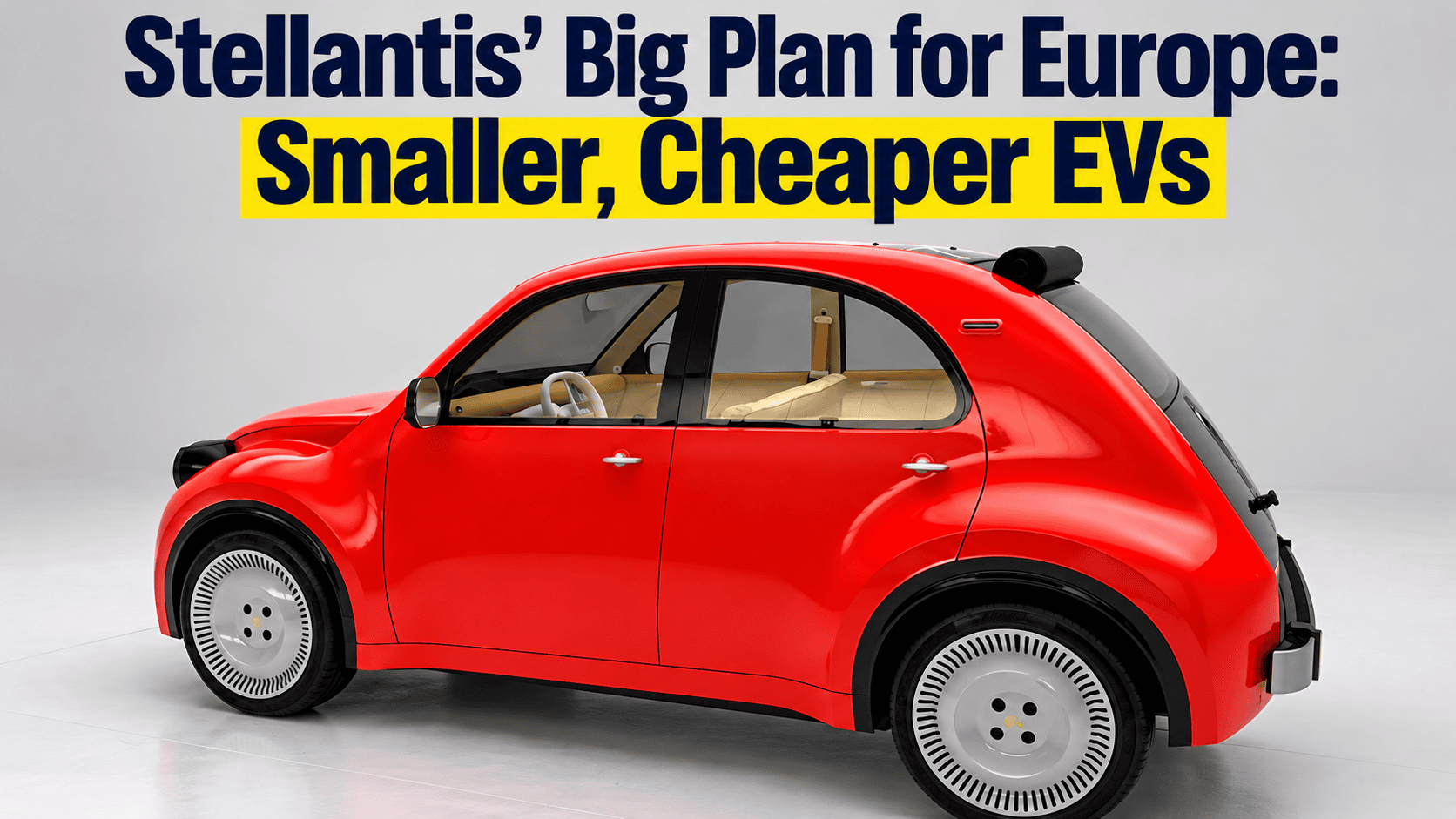
Stellantis affordable EVs: A comprehensive guide to the strategy, models and buyer benefits
Research updated: 12 October 2026
Summarise this blog post with: ChatGPT | Perplexity | Claude | Grok
If you have been shopping for an electric car, you have probably compared prices and advertised range. But Stellantis’ push toward smaller, cheaper EVs raises another question: what will you actually get for less money? This guide explains the strategy, separates existing cars from future promises, and highlights what matters before you buy or wait.
Key Takeaways
- Stellantis’ Citroën 2 CV Concept carries a €15,000 price ambition and European production positioning, rather than a confirmed showroom offer. Stellantis
- The electric Citroën 2CV is expected in 2028, according to Reuters; buyers still need final specifications and delivery commitments.
- The Citroën ë-C3 and Fiat Grande Panda Electric already demonstrate the group’s affordable EV approach through production vehicles.
- Shared engineering and battery choices can reduce costs, but future models should not automatically be assigned existing platforms or specifications.
- Small-car suitability depends on passenger space, charging, safety equipment and longer journeys, alongside parking convenience.
- Ownership affordability includes depreciation, electricity, insurance, servicing and financing—not simply the advertised purchase price.
What Is Stellantis’ Plan for Smaller, Cheaper EVs in Europe?
Stellantis’ affordable EV strategy is an effort to make electric mobility more accessible through smaller vehicles, shared engineering and cost-conscious product choices. For buyers, the clearest distinction is between production cars such as the ë-C3 and future proposals such as the 2 CV Concept.
Stellantis is the automotive group behind brands including Citroën, Fiat, Peugeot and Opel. Its October presentation covered several brands and vehicle categories, so the entire concept-car display should not be interpreted as an entry-level EV programme. Stellantis
For this affordability story, Citroën and Fiat provide the most concrete examples. Their existing electric hatchbacks establish a baseline against which future promises can be judged.
[Internal link:https://turbobehind.com/jsws-first-suv-is-coming-a-new-challenger-for-tata/]
Why are smaller, cheaper electric cars a good choice for European buyers?
Smaller, cheaper electric cars have appeal in Europe because of their potential to reduce the purchase price barrier while maintaining utility for shorter trips and limited parking. For instance, a family needing a car for commuting purposes would probably rather have something compact that can be stored in a home garage than a large battery pack for longer range.
The market context for this product is significant.
- EU battery-electric registrations reached 1,641,333 in January–August 2026.
- Battery-electric cars represented 21.7% of new EU registrations, compared with 15.8% during the same period in 2025.
- Overall new EU car registrations increased 5.3% during January–August 2026.
The figures relate to the EU (European Union), not the entire European region, or the broader Stellantis corporate definition of Enlarged Europe.
The cost of ownership for an electric vehicle includes the purchase price, energy, insurance, maintenance, financing, and taxes over the vehicle’s ownership period. A lower purchase price can be offset by higher energy costs in the form of recharging fees at public charging stations.
[Internal link: https://turbobehind.com/porsche-cayenne-electric-without-losing-its-soul/]
What Has Stellantis Announced About the Electric Citroën 2CV?
Stellantis presented the Citroën 2CV Concept as a European-made electric car with a €15,000 price ambition in its 11 October 2026 announcement. The reveal establishes the intended direction, rather than a completed retail proposition. Stellantis
| Milestone | Status | Buyer significance |
|---|---|---|
| 11 October 2026 reveal | Concept presented | Shows the intended product direction |
| €15,000 figure | Announced ambition | Does not establish final local pricing |
| Expected 2028 arrival | Reported timing | Reuters’ expectation, not a personal delivery commitment |
| Orders and deliveries | Not established in the cited reveal | Await national sales announcements |
The electric Citroën 2CV is expected in 2028, according to Reuters’ 11 October 2026 report. That wording matters: “expected” does not mean orders are open. reuters.com
Final country prices, battery capacity, charging performance, equipment and delivery schedules remain details buyers should verify through subsequent announcements. A concept reveal is not a retail launch.
[Internal link:https://turbobehind.com/mercedes-glc-ev-goes-713-kmtesla-should-worry/]
How Can Stellantis Reduce the Cost of Electric Cars?
Stellantis can reduce electric-car costs by sharing development work, buying common components at scale, selecting suitable batteries and simplifying configurations. For example, related cars can use common engineering while retaining different styling and interiors.
How does platform sharing reduce development costs?
Platform sharing means using a common engineering foundation across multiple vehicles. Stellantis’ Smart Car platform is a shared vehicle architecture used by the Fiat Grande Panda, according to Fiat’s January 2025 product announcement. Fiat identifies the Grande Panda as its first Fiat model on that architecture—not the first Stellantis vehicle to use it. Stellantis Media
For example, spreading development and component purchasing across related models can reduce the investment each vehicle must recover. Fewer unique parts can also simplify manufacturing, although the final benefit depends on production volumes and execution.
However, shared architecture does not guarantee identical cars or prices. Equipment, battery sizes, branding and national taxes still affect what customers pay. The same caution applies to future products: the cited 2CV reveal does not justify assigning it the Grande Panda’s platform.
For buyers, the practical question is whether engineering savings produce a useful standard specification. A cheaper trim loses appeal if essential charging equipment or everyday convenience features require costly upgrades.
How do battery choices and simpler specifications help?
Battery selection helps manufacturers balance cost, driving range and vehicle size. LFP means lithium iron phosphate, a battery chemistry used in affordable EVs; the European ë-C3 is a documented example.
The IEA reports that LFP battery packs were more than 40% cheaper per kilowatt-hour on average than NMC alternatives in 2025. However, that comparison includes stationary-storage applications, whose lower energy-density requirements partly influence the difference. It is not a Stellantis-specific saving or a predicted retail discount. — Source: [IEA, 2026] IEA
A smaller battery can reduce the amount of battery capacity a buyer purchases. For example, someone with reliable overnight charging may prefer a modest-range car, while a frequent motorway driver may justify paying for greater capacity.
Simpler configurations can also reduce complexity. Fiat’s original Grande Panda Electric launch used two trims, illustrating a limited-choice approach. Nevertheless, buyers should compare the exact current specification rather than assume every entry-level version includes the same equipment. Stellantis Media
How Do the Citroën ë-C3 and Fiat Grande Panda Illustrate the Strategy?
The Citroën ë-C3 and Fiat Grande Panda illustrate Stellantis’ strategy through production electric cars with documented prices and specifications. Country, variant and source date must stay attached to every figure.
| Model | Country/variant | Status | Dated price | Battery | Combined WLTP range |
|---|---|---|---|---|---|
| Citroën ë-C3 | Portugal, Urban Range YOU | Available production model | €19,990 list; 20 April 2026 announcement | 30 kWh LFP | Up to 212 km |
| Fiat Grande Panda Electric | Italy, POP | Available production model | €23,900; official price-list file labelled May 2026 | 44 kWh | 320 km |
| Citroën 2 CV Concept | Europe; production variant unspecified | Concept; future arrival reported | €15,000 ambition; 11 October 2026 | Not specified in cited reveal | Not specified in cited reveal |
Table sources: Citroën Portugal’s April announcement, Fiat’s Italian price list and Stellantis’ October reveal. Portuguese pricing includes VAT. Fiat’s figure includes VAT and delivery preparation but excludes IPT registration tax and the PFU tyre contribution. These are dated reference prices, not guaranteed October quotations. Stellantis Media
The original European ë-C3 announcement documented a 44 kWh LFP battery and up to 320 km WLTP range. Those specifications belong to that announcement; they must not be attached to the cheaper 30 kWh version. — Source: [Citroën, 2023] Stellantis Media
The Fiat Grande Panda Electric was announced with a 44 kWh battery and 320 km combined WLTP range in January 2025, according to Fiat. Its announced length was 3.99 metres, demonstrating the compact dimensions behind the strategy. — Source: [Fiat, 2025] Stellantis Media
[Internal link:https://turbobehind.com/citroen-aircross-x-pricing-variantfeatures-engine/]
What Should Buyers Check Before Choosing a Small Electric Car?
Buyers should check whether a small electric car meets their space, charging, safety and longer-distance needs before judging its price. For example, a car that handles weekday commuting comfortably may require inconvenient charging stops on regular family trips.
WLTP is a standardised vehicle-testing procedure, and its range figure provides a comparison reference rather than a guaranteed journey distance. Plan with a reserve for weather, speed, luggage and diversions.
A useful test-drive checklist includes:
- Passenger space: Fit child seats and check rear-seat access.
- Luggage capacity: Bring a pushchair or regular travel bags.
- Motorway suitability: Assess comfort and realistic charging stops.
- Charging performance: Compare charging time, not only peak power.
- Battery warranty: Check duration, mileage, capacity protection and exclusions.
- Safety: Match independent results to the model, test year and equipment.
Euro NCAP explains that some cars receive separate ratings for standard equipment and an optional safety package. Manufacturer equipment claims therefore should remain separate from independent crash-test findings. Euro NCAP assessment areas
What Could Help or Hinder Stellantis’ Affordable EV Plan?
Stellantis’ affordable EV plan depends on converting lower production costs into appealing cars, dependable deliveries and sustained customer demand. For example, high manufacturing capacity offers little benefit if customers reject the available specification.
Competition can encourage better value, but persistent discounting can weaken the economics supporting future products. Brand differentiation also matters: shared components should still produce cars with clear reasons to choose them.
Leapmotor is a partnership case as well as part of the wider Chinese automotive landscape. Stellantis’ May 2026 announcement described plans to expand cooperation, including joint purchasing intended to improve European EV affordability. Leapmotor International is a 51% Stellantis/49% Leapmotor joint venture. — Source: [Stellantis, 2026] Stellantis
Charging access remains another practical constraint. An apartment resident without predictable nearby charging faces a different ownership proposition from a driver with a driveway.
For Indian readers, the relevance is the manufacturing and affordability approach. These European announcements do not establish an Indian launch, specification or price.
Which Tools Help Buyers Evaluate Affordable EVs?
The most useful EV-buying tools combine local vehicle quotations, warranty documents, independent safety results and charging-location information. Use them to test a realistic ownership scenario before paying a deposit.
- National manufacturer configurators: Compare cash prices, equipment and finance totals.[Insert image: Local Citroën or Fiat configuration with country, trim and price conditions visible | Alt text: “Compare Stellantis affordable EVs using local manufacturer prices”]
- Euro NCAP: Check the exact model, rating year and safety-package applicability.[Insert image: Relevant Euro NCAP result with equipment notes | Alt text: “Check small electric car safety using Euro NCAP”]
- PlugShare: Investigate nearby charging locations, then confirm tariffs and availability with the operator.[Insert image: Charging map around a sample apartment and workplace | Alt text: “Find nearby EV charging locations with PlugShare”]
- A calculator or spreadsheet: Calculate energy costs and add the remaining ownership expenses.
Annual charging cost = annual kilometres × billed kWh per 100 km ÷ 100 × electricity price.
| Illustrative profile | Explicit assumptions | Calculated annual charging cost |
|---|---|---|
| Home-charging commuter | 12,000 km; 17 billed kWh/100 km; €0.25/kWh | €510 |
| Public-charging apartment resident | 12,000 km; 17 billed kWh/100 km; €0.55/kWh | €1,122 |
These are illustrative calculations, not measured model results or current tariff quotations. Consumption includes assumed charging losses; parking, subscriptions and session fees are excluded. The €612 difference shows how charging access can change affordability without changing the car.
Should Buyers Purchase an Available EV or Wait for Future Models?
Buyers should choose an available EV when its verified price and capabilities meet their needs, and consider waiting when their current transport remains suitable. A future target price alone is insufficient grounds for postponing a necessary purchase.
Before relying on an upcoming Stellantis model, look for:
- Production confirmation and final specifications.
- Country-level order-book openings.
- Published prices and equipment lists.
- Battery and vehicle warranty documents.
- Credible first-delivery dates and independent reviews.
Conclusion
Stellantis’ affordable EV plan will succeed if accessible transaction prices come with useful everyday capability, dependable supply and customer adoption. The ë-C3 and Grande Panda offer production-car evidence; the 2 CV Concept adds a future ambition.
For your next purchase, compare the complete ownership proposition. A cheaper electric car becomes good value when it makes your daily driving both affordable and practical.
Written by: Sourav Ranjan, content writer covering automotive developments and practical buyer considerations.