
Summarize this blog post with: ChatGPT | Perplexity | Claude | Grok
If you’re considering a ₹1.26 crore electric SUV, you probably expect exceptional comfort, useful technology and effortless family travel. But a premium price cannot tell you whether the seats, charging routine and ownership package suit your life. In this comprehensive Volvo EX90 EV India buying guide, we explain what the money buys—and what deserves a closer look.
Published: 14 October 2026. Specifications checked: 14 October 2026.
Key Takeaways
- The Volvo EX90 is a fully electric luxury SUV offered in India with six seats and second-row captain’s chairs.
- The introductory price is ₹1.26 crore, ex-showroom, according to CarWale’s launch report dated 12 October 2026.
- The India-spec Twin Motor powertrain combines all-wheel drive with a 106kWh nominal battery and an 800V electrical system.
- The advertised range and charging figures carry qualifications and conflicting website footnotes.
- The family buying decision should include third-row comfort, luggage space, charging access and written ownership terms.
What Is the Volvo EX90, and Which Version Is Available in India?
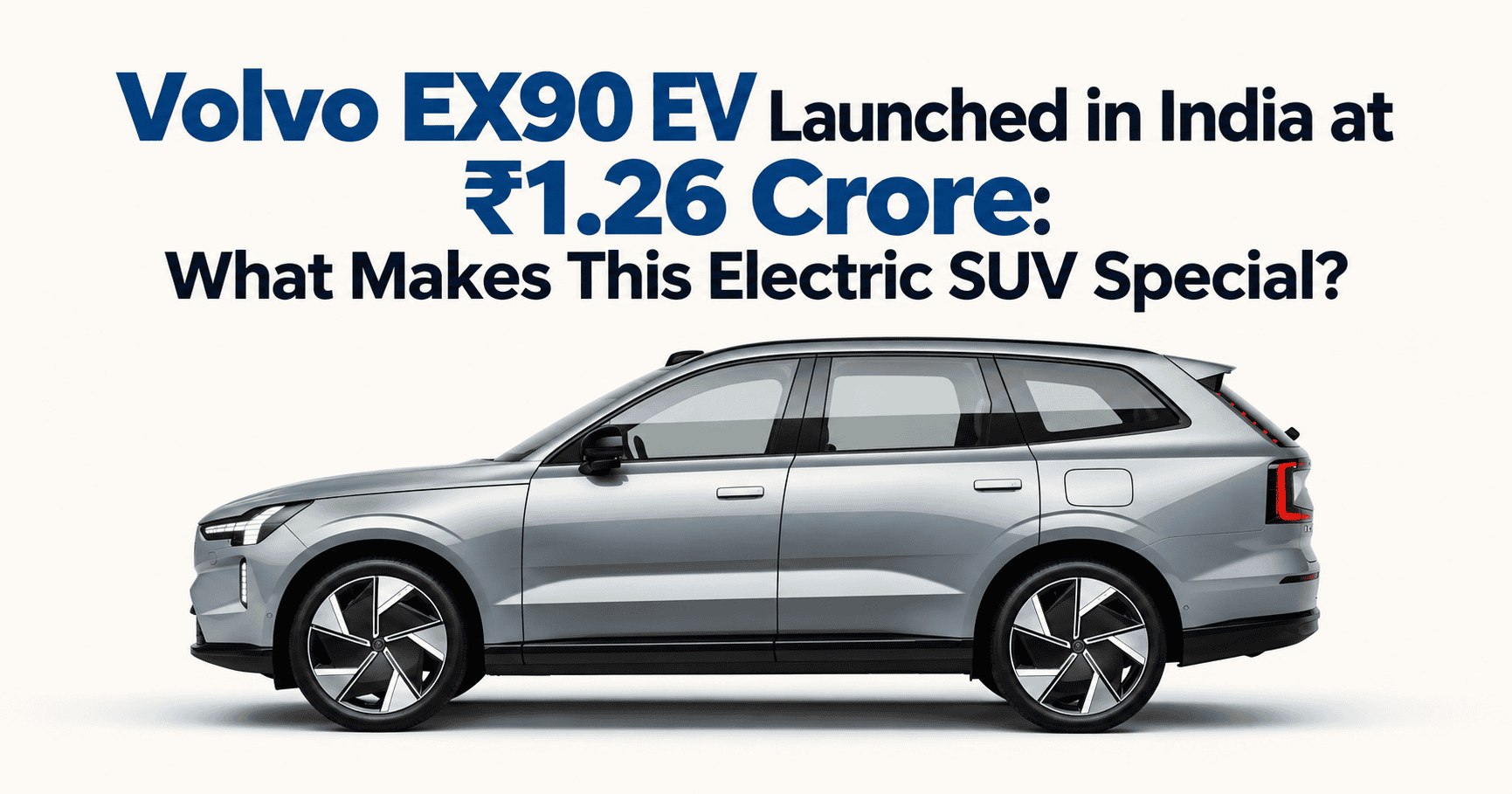
The Volvo EX90, an electric luxury SUV, will be available in India in a six-seater configuration, as per the automaker’s official statement.
In particular, the Swedish automaker specifies the Ultra trim level and a 2027 model year, which is distinct from the Indian launch date of the XC90 — October 2026. — Source: Volvo Cars India, accessed 2026.
In practice, the EX90 accommodates three rows of seats with two individual seats in the second row, and it should be considered as a standalone proposition, rather than an evolution of the XC90.
[https://turbobehind.com/mercedes-benz-global-sales-fall-6-india-sales/]
Why Does the Volvo EX90 India Launch Matter?
The launch of the Volvo EX90 in India means that there are now three-row electric SUVs for discerning buyers to consider.
Families that need to seat their loved ones in separate second-row seats while still having the flexibility to accommodate more passengers will find that they have one more car to consider. Passenger comfort will dictate the shortlist.
Still, the acquisition will change regular owners’ lives in other ways. Those with reliable home charging have a radically different experience than those who have to use public charging stations.
[https://turbobehind.com/mercedes-glc-ev-goes-713-kmtesla-should-worry/]
What Comes with the Volvo EX90’s ₹1.26 Crore Price?
The Volvo EX90 begins at ₹1.26 crore ex-showroom in India, according to a report by CarWale dated 12 October 2026. — Source: CarWale, 2026.
As of 14 October 2026, this price appears to be the vehicle base cost. Ask for a breakdown that separates the above from insurance, applicable registration charges and taxes, accessories, charging installation and optional packages.
In addition, Autocar India reports a special introductory offer for bookings before 31 December 2026: 11kW home charger, three-year service package and 65% assured buyback after three years. The review does not disclose all the terms and conditions of this offer – ask in writing about mileage restrictions, deductions and eligibility for this buyback guarantee. — Source: Autocar India, 2026.
Concerning availability, Volvo offers a test drive request form, but the pages examined do not state when test drives will begin or what the general delivery time frame is likely to be. Ask your dealer about demonstrator car availability, cancellation policy for a test drive and general delivery estimates for the allocation you are considering.
What Battery and Powertrain Does the India-Spec Volvo EX90 Use?
The India-spec Volvo EX90 Twin Motor has a 106kWh nominal battery and all-wheel drive, according to Volvo Cars India’s specifications.
Specifically, AWD means all-wheel drive, while kWh measures stored energy and kW measures power. Nominal battery capacity must not be presented as confirmed usable energy.
| Specification | Volvo India’s published figure |
|---|---|
| Powertrain | Twin Motor AWD |
| Electrical system | 800V |
| Battery capacity | 106kWh nominal |
| Maximum power | 335kW |
| Maximum torque | 670Nm |
| Claimed 0–100km/h | 5.5 seconds |
| AC onboard charger | 11kW |
| AC charging, 0–100% | 10 hours, three-phase 16A |
| DC charging, 10–80% | 22 minutes, labelled DC 350kW |
Source: Volvo Cars India specifications, accessed 2026. Figures are manufacturer claims; charging qualifications appear below. Volvo Cars India
For everyday ownership, acceleration is only part of the assessment. Test how smoothly the car responds in traffic, how easily you modulate braking and whether passengers feel comfortable.
What Is the Volvo EX90’s Claimed Range in India?
Volvo advertises up to 625km of preliminary WLTP range, but its overview footnote references a seven-seat configuration rather than India’s six-seat model. — Source: Volvo Cars India, accessed 2026.
For clarity, WLTP is a standardised vehicle-testing procedure. A laboratory-based range estimate is not a promise about your next journey.
For example, sustained highway speeds, temperature, passenger load and air-conditioning use can change consumption. Route planning should include a charging reserve and an alternative station.
Crucially, request the certification document applicable to the ordered vehicle. Do not treat the published figure as a measured Indian road-test result, or compare it directly with another SUV’s figure from a different testing cycle.
How Long Does the Volvo EX90 Take to Charge?
Volvo publishes approximately 10 hours for a full AC charge under its specified three-phase conditions and 22 minutes for a 10–80% DC charge, subject to qualifications.
What should buyers know about home and highway charging?
First, the DC headline needs clarification: Volvo’s overview labels the session as 350 kW, while the accompanying fine print mentions a 250kW station. Buyers should request corrected documentation before relying on either specification.
In practice, a charger’s maximum rating does not mean the vehicle receives that output throughout a session. Battery temperature, charge level and station limitations affect charging speed. A peak charging figure is not an average charging rate.
For home use, a charging assessment involves checking the parking location, electricity supply, installation requirements and applicable tariff before selecting a charger. An electrician should assess sanctioned load, earthing, protection equipment and cable routing; apartment residents should also confirm installation permission.
For example, convenient overnight top-ups may matter more than the fastest advertised DC session. Drivers without private charging should test nearby stations at their usual travel times before booking.
Which Safety and Software Features Make the EX90 Distinctive?
The EX90’s distinctive safety and software proposition combines driver assistance, occupant sensing and connected controls, although equipment and activation must be confirmed for the ordered vehicle.
Which functions should buyers verify at the dealership?
According to Volvo, Pilot Assist supports steering, acceleration and braking while requiring driver supervision. Occupant sensing can alert the driver when someone remains inside, while door-opening alerts can warn about approaching traffic. These systems assist people; they do not make the car autonomous. Volvo Cars India
Additionally, India launch reporting lists airbags, a 360-degree camera and parking assistance. Ask the dealer to demonstrate the functions fitted to the actual specification rather than relying on international promotional videos.
For software, Volvo describes Google-based navigation and over-the-air updates. However, a software-update capability does not establish that every advertised function is active at delivery.
Before paying, obtain three separate lists: included and active features, paid options, and functions awaiting activation. India-specific LiDAR fitment and usable bidirectional charging were not established by the reviewed material, so neither should be assumed as a purchase benefit.
How Practical Are the Volvo EX90’s Six Seats and Third Row?
The Volvo EX90’s family practicality depends on passenger size, third-row access and luggage needs—not simply its six-seat designation.
Notably, Autocar India reports that the captain’s chairs lack the powered adjustment, ventilation, heating and massage offered up front. Its assessment describes the third row as better suited to children or adults on shorter journeys. These are attributed observations, not findings from this article’s author.
For luggage, Volvo lists 324 litres with the third row raised under its “open” capacity measurement. The SUV measures 5,037mm long and 2,113mm wide, including mirrors. — Source: Volvo Cars India, accessed 2026.
In practice, bring your stroller, suitcases and child seats to the showroom. Check approved anchorage positions in the manual, access with child seats installed, and whether older relatives can enter comfortably.
Similarly, try adjusting climate settings and opening parking-camera views while stationary. A screen-heavy cabin should feel manageable to every regular driver.
How Can Buyers Check Charging Costs and Compare Rivals?
A practical EX90 assessment combines a charging-cost calculation, a route check and comparable written quotations.
For example, assume an illustrative session adds 50kWh to the battery, with 90% charging efficiency and electricity priced at ₹8/kWh:
- Grid electricity: 50 ÷ 0.90 = 55.6kWh
- Electricity cost: 55.6 × ₹8 = about ₹445
For clarity, these are assumptions, not measured EX90 results. Charging cost equals electricity drawn from the grid multiplied by the applicable tariff. Add any session, parking or other applicable charges separately.
For route planning, use Google Maps to identify potential stops, then check station status through the operator and confirm backup locations. A free alternative is to contact the charging site directly.
For rival context, compare equivalent ex-showroom prices rather than mixing them with on-road quotations:
| Vehicle | Price reference checked in October 2026 | Why test it? |
|---|---|---|
| Volvo EX90 Ultra | ₹1.26 crore introductory | Assess its overall family and technology package |
| Kia EV9 GT-Line AWD | ₹1,29,91,312 | Examine second-row powered adjustment and massage |
| Mercedes-Benz EQS SUV 580 4MATIC | ₹1,47,50,000 | Assess its cabin, seating and driving experience |
What Should Buyers Check Before Booking the Volvo EX90?
The best next step is to verify the exact vehicle, charging setup and ownership contract before paying a booking amount.
- Confirm the specification: Record model year, seating, equipment and active software.
- Request the complete quotation: Separate mandatory costs, optional products and offer conditions.
- Assess charging installation: Confirm supply, permissions, installation scope and costs.
- Test family suitability: Try every row, child seats, luggage and your parking space.
- Review ownership terms: Check vehicle and battery warranty duration, kilometre limits, capacity-retention conditions, exclusions and service support.
- Confirm delivery terms: Obtain booking cancellation rules and an allocation-specific estimate.
In particular, a family-focused electric SUV test drive involves checking access to every seating row, passenger comfort, luggage space and the usability of everyday controls.
Conclusion: Is the Volvo EX90 Worth Shortlisting?
The Volvo EX90 is worth shortlisting if its six-seat layout, technology and charging requirements suit your family.
Ultimately, the compelling question is what ₹1.26 crore buys in daily usefulness. Passenger comfort, manageable controls and dependable charging matter more than an impressive specification sheet.
Before booking, test the EX90 against your family’s space requirements and regular routes, then obtain written confirmation of equipment, warranty and delivery terms.
Written by: Sourav Ranjan, content writer — automotive explainers and buyer-focused content.