
Summarise this blog post with: ChatGPT | Perplexity | Claude | Grok
If you drive an electric car, charging usually means parking and plugging in. Honda has developed technology to charge electric vehicles wirelessly while moving, but its latest announcement describes development and planned testing—not a consumer launch. In this guide, we’ll explain how the system works, what remains unproven, and what it could mean for your future journeys.
Sources checked: 9 October 2026
Key Takeaways
- Dynamic wireless charging supplies electricity to compatible vehicles moving over equipped road sections.
- Stationary wireless charging transfers energy while a vehicle remains parked over charging equipment.
- Honda’s project remains under development, with further verification planned.
- Compatible receivers are necessary; ordinary EVs cannot automatically charge from an equipped road.
- Smaller batteries and fewer charging interruptions are potential benefits, dependent on infrastructure and operating conditions.
- Indian availability has no launch date in the reviewed Honda announcement.
What Is Honda’s Wireless EV Charging Technology?
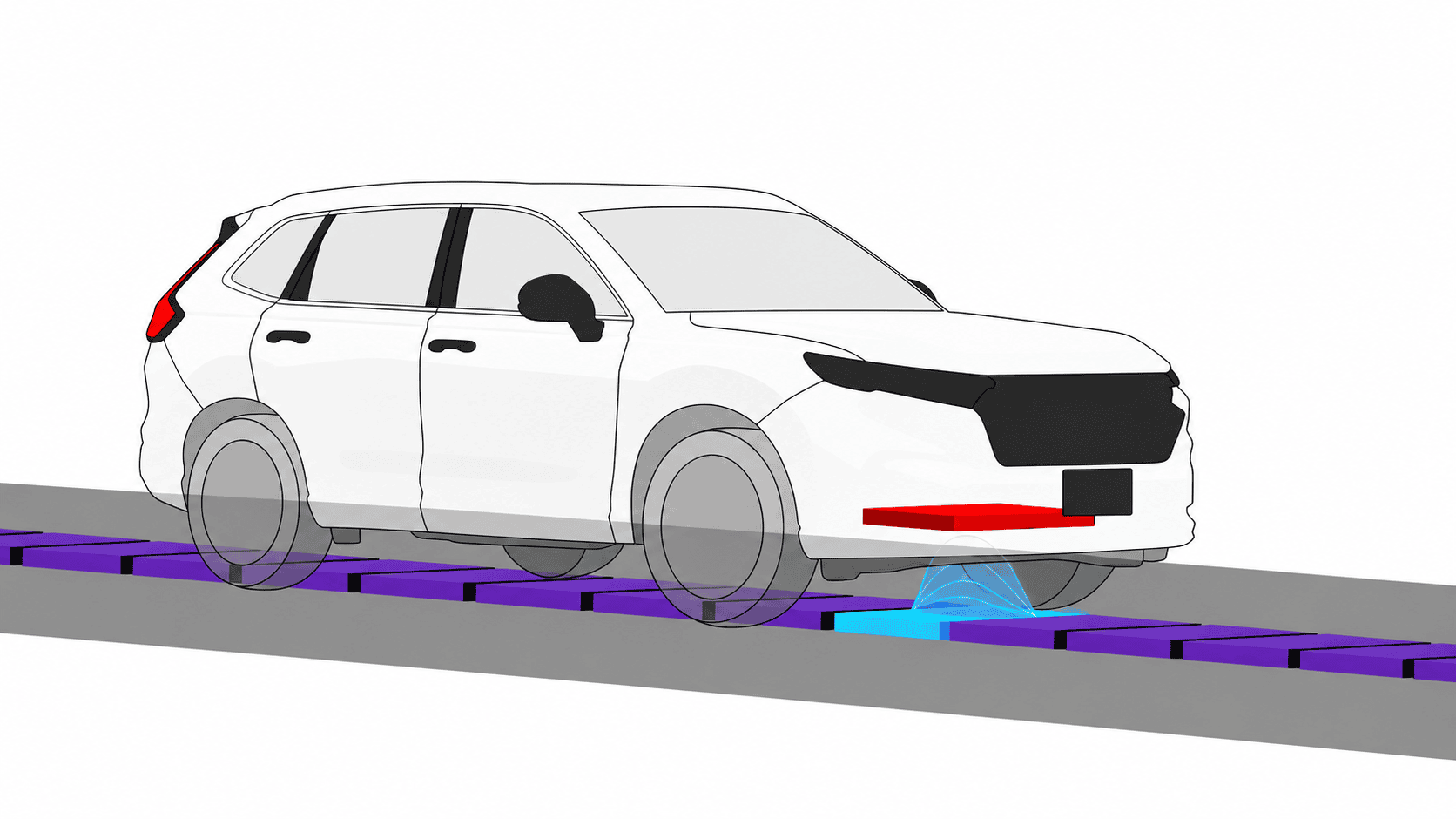
Honda wireless EV charging technology is a system designed to transfer electricity from road equipment to a compatible moving vehicle through magnetic coupling. For example, an equipped truck could receive power while travelling above transmitters embedded beneath the road surface.
More specifically, dynamic wireless power transfer is the contactless delivery of electrical energy from road equipment to a moving vehicle. “Dynamic” describes movement during energy transfer; a wireless smartphone charger provides a familiar introduction to contactless charging, although road systems face very different demands.
In practice, the technology requires equipment on both sides of the air gap. A road needs transmitters, while a vehicle needs a suitable receiver and associated electronics. NEXCO East explains that its planned demonstration equipment will detect compatible vehicles before transmitting power.
[Internal link: https://turbobehind.com/top-5-evs-cars-under-%e2%82%b925-lakh-in-india-say-goodbye/]
Why Does Charging While Driving Matter?
Charging while driving matters because energy received during a journey could reduce the need for separate charging stops. For example, a delivery truck using an equipped route might need less charging time between trips.
However, useful outcomes depend on how much energy reaches the vehicle, how frequently it encounters equipped roads, and how much electricity it consumes. Receiving some power does not automatically mean the battery percentage rises: the vehicle might use electricity faster than the road supplies it.
Similarly, widespread road charging could allow some vehicles to operate with less onboard battery capacity, a potential benefit identified by NEXCO East. A truck still needs sufficient stored energy for unequipped roads, diversions, and interruptions.
Ultimately, a successful demonstration does not establish an affordable charging service. An operator would still need to compare construction, electricity, maintenance, and vehicle costs against the value of reduced downtime.
How Does Honda’s Charging-While-Driving System Work?
Wireless EV charging involves transferring energy through a magnetic field between a transmitter and a compatible vehicle receiver. For example, a road coil and an underbody receiver exchange energy without a cable connecting them. Honda describes this magnetic-field mechanism in its technology overview.
First, the process can be understood in four steps:
- Electricity reaches roadside equipment. The supply system prepares and distributes electrical power.
- Embedded transmitters generate a changing magnetic field. Power electronics drive the road coils.
- Compatible vehicle equipment receives energy. A receiver converts the magnetic interaction into electrical power.
- Onboard systems manage the power. Vehicle electronics regulate how the received electricity enters the vehicle’s electrical system.
What Is the Difference Between kW and kWh?
Kilowatts measure power, while kilowatt-hours measure energy. For example, receiving an average of 60 kW for one minute transfers 1 kWh: 60 multiplied by 1/60 of an hour.
Importantly, a high power figure says little about total energy without a duration. A vehicle passing briefly over a transmitter receives less energy than a vehicle receiving the same power for several minutes. Equipped road length and vehicle speed therefore matter alongside charging power.
Also, received energy is different from net battery gain. In a simplified example, a moving vehicle receiving 60 kW while consuming 40 kW would have approximately 20 kW remaining before additional losses and system constraints. This example explains the arithmetic; it does not describe measured Honda performance.
When reading future trial results, check where power was measured. Grid input, transmitter output, vehicle-received power, and battery charging power represent different points in the system.
How Does Dynamic Wireless Charging Differ From Parked Wireless Charging?
Stationary wireless EV charging is contactless charging performed while a vehicle is parked over charging equipment. For example, a compatible car could charge above a charging pad without the driver connecting a cable. Honda has previously presented stationary wireless charging concepts.
By comparison, dynamic charging must transfer energy as the receiver moves past successive road transmitters.
| Feature | Parked wireless charging | Dynamic wireless charging |
|---|---|---|
| Vehicle position | Remains above a pad | Moves over equipped sections |
| Equipment placement | Parking space or designated bay | Along a road or lane |
| Transfer duration | Determined largely by parking time | Determined by speed and equipped coverage |
| Example application | Charging during an overnight stop | Supplementing energy during a freight journey |
For context, Oak Ridge National Laboratory reported a separate vehicle-integrated demonstration at 100 kW, with 96% efficiency, across a five-inch air gap in 2024 — Source: Oak Ridge National Laboratory, 2024. These are results from that particular system, not Honda’s moving-road performance.
What Did Honda Announce About Wireless Charging in October 2026?
Honda announced underlying road-charging technology developed with Taisei and Taisei Rotec, with additional testing ahead. The design integrates an inverter and coil within a road unit and uses DC distribution. An inverter converts direct current into alternating current needed to drive the coil.
Specifically, Honda attributes its “world first” claim to this integrated DWPT unit design, based on its research into public disclosures through September 2026. The claim does not mean Honda invented all wireless vehicle charging.
| Status | What readers should understand |
|---|---|
| Confirmed | Development of the underlying technology and integrated road-unit architecture |
| Planned | Further durability, electromagnetic-field, and power-transfer verification |
| Not established | Commercial pricing, universal compatibility, or an India launch |
Has Honda Demonstrated 150 kW Charging on Public Roads?
Honda’s announcement does not establish a completed 150 kW public-road demonstration. Honda plans to verify wireless power transfer at outputs up to 150 kW, according to its October 5, 2026 announcement — Source: Honda, 2026. Honda Global Corporate Website
For independent context, a separate Purdue-led roadway project reported 85 embedded coils, delivery of 50–190 kW, and operation at speeds up to 65 mph. These results concern different equipment, vehicles, and test conditions. They cannot validate Honda’s targets.
More usefully, future Honda reports should describe sustained received power, vehicle speed, alignment, and measurement boundaries together. A peak reading alone would not tell you how much energy a truck receives during a complete journey.
For example, an operator comparing two demonstrations would need to know whether both reported battery-side power or whether one reported electricity entering roadside equipment. Comparable measurements matter more than isolated headline numbers.
What Challenges Could Delay Wireless Charging Roads?
Wireless charging roads face deployment questions involving construction, maintenance, energy losses, compatibility, and electricity supply. For example, replacing failed equipment beneath a busy freight lane could involve both electrical repairs and road closures.
First, several questions deserve answers before broad deployment:
- Installation cost: What does each equipped kilometre cost, including civil works?
- Road maintenance: Can crews repair pavement without damaging charging equipment?
- Energy losses: How much grid electricity becomes usable vehicle energy?
- Alignment: How does lateral movement affect transfer performance?
- Interoperability: Can vehicles from different manufacturers use the same installation?
- Grid connections: Can the local supply serve several vehicles simultaneously?
- Electromagnetic exposure: What measurements demonstrate acceptable operation?
- Billing: How are vehicles identified and delivered energy charged?
Technically, coil geometry, ground clearance, alignment, efficiency, and stray magnetic fields interact; ORNL research identifies these as linked design considerations. For example, performance established at one receiver height cannot simply be assumed at another.
Crucially, the reviewed announcements do not provide a commercial cost-per-kilometre model or a customer tariff. A deployment decision needs operating evidence alongside engineering evidence.
Where Could Wireless Charging Be Used, and How Can You Estimate Its Benefit?
Wireless road charging could serve repeat-route commercial vehicles, and Honda identifies logistics and transportation as its initial practical focus. For example, a freight corridor used regularly by compatible trucks offers a clear scenario for evaluating infrastructure use. Honda Global Corporate Website
In a hypothetical freight-route example, assume a truck receives an average of 60 kW for a cumulative six minutes during its journey. The calculation is:
Energy received = average received power × time
60 kW × (6 ÷ 60 hours) = 6 kWh
Importantly, these are illustrative assumptions, not Honda test figures. “Average received power” must include variations during the counted period; the calculation also excludes downstream losses and electricity consumed by driving.
For a free calculation tool, use a phone calculator or a spreadsheet. In Google Sheets, enter average received power in cell A2, minutes in B2, and =A2*B2/60 in C2.
Alternatively, calculate 60 × 6 ÷ 60 with a phone calculator.
When Will the Tateyama Expressway Trial Begin, and What Should Indian Readers Watch?
The Tateyama Expressway wireless charging demonstration is planned from fiscal year 2027 onward, according to NEXCO East. The planned test area is near the Kimitsu Parking Area, within a stretch of approximately 300 metres
For timing, Honda specifies that Japanese fiscal year 2027 begins on 1 April 2027. That identifies a planning period; it does not promise a commercial opening on that date. Honda Global Corporate Website
For India, the reviewed Honda announcement gives no rollout date. Existing EV owners should seek manufacturer-confirmed compatibility rather than assume that a software update will enable road charging.
Before treating dynamic charging as a purchase benefit, check:
- Published trial results: Received energy, speed, reliability, and losses.
- Compatible vehicles: Specific models and required equipment.
- Infrastructure coverage: Actual routes and operating availability.
- Pricing: Equipment costs and charging tariffs.
- Local announcements: Confirmed Indian projects and timelines.
Conclusion
Honda wireless EV charging technology is a project whose primary value lies in being demonstrated in practice. As a driver, the critical factor influencing my choice between alternative road vehicles is the extent to which a given infrastructure can provide affordable energy in practice.
Therefore, it is advisable to wait for working prototypes, their technical tests, and the corresponding cost-benefit analyses before investing in the infrastructure. All of these factors will indicate whether the technology is viable for my car or the company’s vehicles in the long run.
Written by: Sourav Ranjan, content writer. This article focuses on automotive technology and its practical implications for EV users.