
Summarise this blog post with: ChatGPT | Perplexity | Claude | Grok
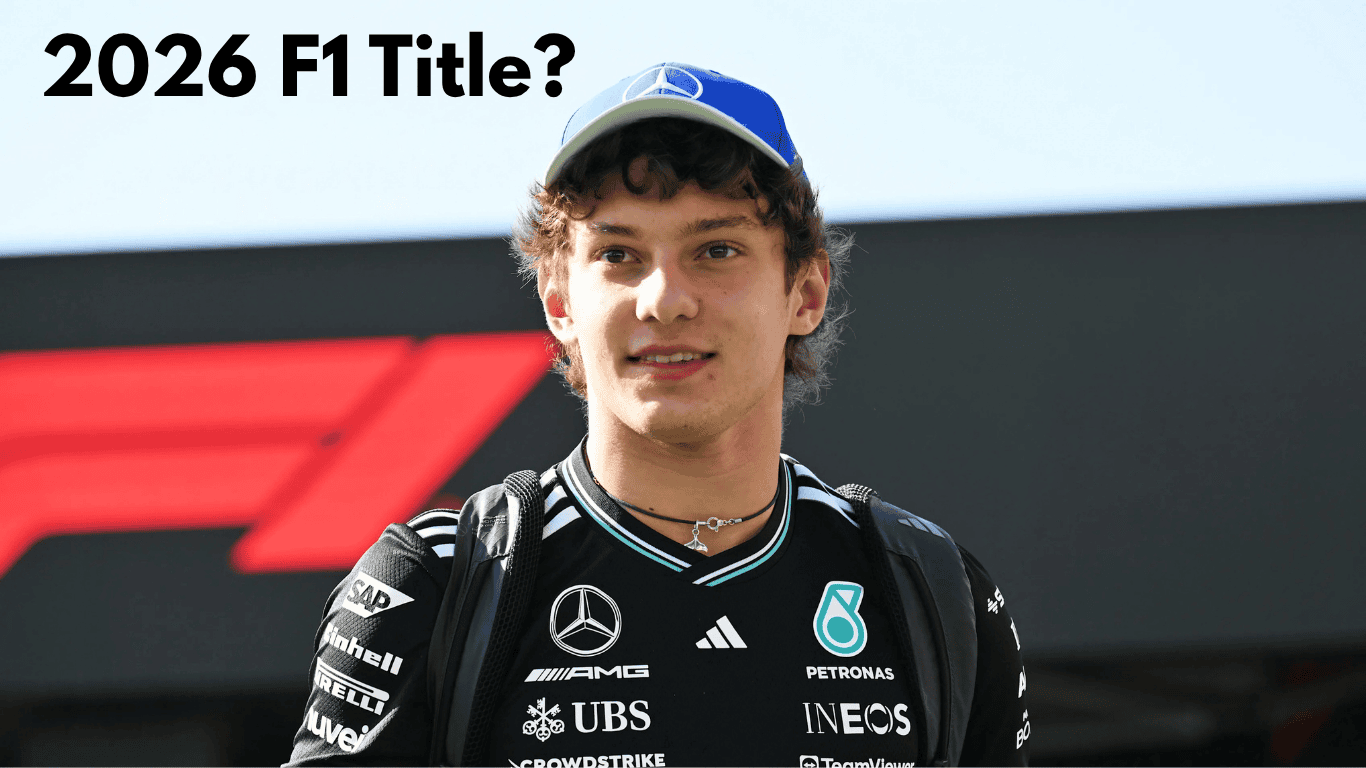
You already know Kimi Antonelli is leading the 2026 F1 Drivers’ Championship, and his 66-point advantage over George Russell looks enormous. But a championship lead is not the same as a championship secured, and the remaining races still leave several ways for the gap to change. This guide breaks down exactly who can challenge Antonelli, what each rival would need to do, and which factors could decide the 2026 title race.
Key Takeaways
- Kimi Antonelli leads the 2026 F1 Drivers’ Championship with 302 points, 66 ahead of George Russell before the Bahrain Grand Prix weekend at Sepang.
- George Russell is the closest challenger, having reduced Antonelli’s previous 81-point advantage to 66 points with his Azerbaijan Grand Prix victory.
- Eight championship rounds remained at the start of the Bahrain-in-Malaysia weekend, so Antonelli had not mathematically secured the title.
- Up to 208 points remained available across the eight rounds because Singapore includes a Sprint weekend.
- Lewis Hamilton, Lando Norris, Charles Leclerc and Max Verstappen remain mathematically alive, although their championship gaps are considerably larger than Russell’s.
- Mercedes performance and reliability are central to the title battle because Antonelli and Russell drive for the same team and share the same basic car platform.
- The most useful championship measure is the points gap after each weekend, not predictions about who will eventually win.
What Is the 2026 F1 Championship Battle?
The 2026 F1 Drivers’ Championship is the season-long competition for the Formula 1 World Drivers’ Championship, and Kimi Antonelli currently leads it with 302 points. George Russell has 236, Lewis Hamilton 199, Lando Norris 186, Charles Leclerc 179 and Max Verstappen 163 before the Bahrain Grand Prix weekend at Sepang. (Formula 1® – The Official F1® Website)
Moreover, Antonelli’s 66-point advantage is significant because Russell is the only driver currently within 100 points of the Mercedes leader. The gap became smaller after Russell won in Azerbaijan while Antonelli recovered from a difficult qualifying position to finish fifth.
For example, the standings entering this weekend looked like this:
| Position | Driver | Team | Points | Gap to Antonelli |
|---|---|---|---|---|
| 1 | Kimi Antonelli | Mercedes | 302 | — |
| 2 | George Russell | Mercedes | 236 | 66 |
| 3 | Lewis Hamilton | Ferrari | 199 | 103 |
| 4 | Lando Norris | McLaren | 186 | 116 |
| 5 | Charles Leclerc | Ferrari | 179 | 123 |
| 6 | Max Verstappen | Red Bull | 163 | 139 |
Source: Formula 1 official 2026 Drivers’ Standings. (Formula 1® – The Official F1® Website)
In addition, the current race has an unusual context because the Bahrain Grand Prix is being held at Malaysia’s Sepang International Circuit. Formula 1 and the FIA confirmed that Sepang would host the postponed Bahrain event from October 2–4, preserving the race on the 2026 championship calendar.
[Internal link: https://turbobehind.com/lando-norris-2025-champion-race-broke-verstappen/]
Table of Contents
How Many Points Does Kimi Antonelli Lead By in the 2026 F1 Championship?
Kimi Antonelli leads George Russell by 66 points entering the Bahrain Grand Prix in Malaysia. The same official standings show Antonelli on 302 and Russell on 236.
At the same time, the size of the gap needs context. Russell previously faced an 81-point deficit, meaning his Azerbaijan victory and Antonelli’s fifth-place finish produced a 15-point swing in the championship gap.
That swing demonstrates why a large F1 championship lead can change quickly. One driver does not necessarily need a dramatic collapse from the leader; repeated differences of 10–20 points can gradually reshape the standings.
Why Does Antonelli’s 2026 Championship Lead Matter?
Antonelli’s championship lead matters because a 66-point advantage gives him a substantial points cushion while eight rounds remain. The advantage is large, but it is not mathematically decisive before the remaining scoring opportunities are exhausted.
More importantly, the championship situation is different from a normal race result. A driver can finish second while their closest rival wins, and the points gap can still move by seven points; a DNF can create a much larger swing.
For example, a full Grand Prix win is worth 25 points under the standard scoring structure, while second place receives 18. Therefore, if Russell wins while Antonelli finishes second, Russell gains seven points in one Grand Prix.
The practical question is therefore not simply “Can Russell win?” It is “Can Russell consistently score substantially more points than Antonelli over the remaining rounds?”
Why Is a 66-Point Lead Not the Same as a Championship Win?
A championship points lead is not the same as a mathematically secured title because drivers can continue scoring points until one driver has an uncatchable advantage.
In other words, Antonelli needs to build enough separation that no combination of remaining race and Sprint results can allow another driver to finish ahead of him in the final standings.
This distinction becomes especially important in 2026 because eight rounds remained entering Sepang, including one Sprint weekend at Singapore. Formula 1 calculated that 208 points were still available to a driver capable of winning every remaining Grand Prix and the Singapore Sprint.
Can George Russell Still Catch Kimi Antonelli in the 2026 F1 Championship?
George Russell can still mathematically catch Kimi Antonelli because Russell trails by 66 points while a maximum of 208 points was still available across the remaining eight rounds.
Furthermore, Russell is the clearest direct challenger because he sits only 66 points behind his Mercedes teammate. His Azerbaijan victory reduced the gap from 81 points, showing that a strong weekend can produce a meaningful championship swing.
The simplest mathematical target is an average championship swing of more than 8.25 points per remaining round if Russell wants to erase a 66-point deficit across eight rounds.
| Russell’s average advantage per round | Approximate eight-round swing |
|---|---|
| 5 points | 40 points |
| 8 points | 64 points |
| 9 points | 72 points |
| 10 points | 80 points |
| 15 points | 120 points |
| 20 points | 160 points |
This is only a mathematical illustration, not a prediction. Actual F1 scoring varies because finishing positions, Sprint results, DNFs and other circumstances can produce very different weekend totals.
What Results Would George Russell Need to Beat Antonelli?
George Russell would need to outscore Antonelli by at least 67 points across the remaining championship opportunities to finish ahead if no other tie-breaking situation intervenes.
For example, a Russell victory combined with Antonelli finishing second produces a seven-point gain, meaning Russell would need roughly ten such seven-point swings to eliminate a 66-point deficit. That illustrates why simply winning races is not enough if Antonelli consistently finishes immediately behind him.
At the same time, the calculation changes dramatically when Antonelli has a poor result. A Russell win worth 25 points combined with an Antonelli retirement worth zero produces a 25-point championship swing in one Grand Prix.
That is why reliability is such an important part of this title battle.
What Happened to Russell’s Championship Gap in Azerbaijan?
George Russell cut Antonelli’s championship advantage from 81 points to 66 points at the Azerbaijan Grand Prix. Russell won the race, while Antonelli finished fifth after starting much further back on the grid.
Moreover, the result changed the tone of the championship because Russell had previously suggested that the title fight was moving away from him. Formula 1 described the Azerbaijan result as bringing Russell back into the championship conversation.
Can Lewis Hamilton Still Win the 2026 F1 World Championship?
Lewis Hamilton remained mathematically capable of challenging for the 2026 championship because he entered the Sepang weekend on 199 points, 103 behind Antonelli.
However, Hamilton’s mathematical route requires a larger sustained points swing than Russell’s. Erasing 103 points over eight rounds would require an average advantage of approximately 12.9 points per round.
For example, Hamilton would need to combine frequent high finishes with comparatively low-scoring weekends from Antonelli. A single victory would not be enough to remove a 103-point deficit.
At the same time, Hamilton’s position matters because Ferrari can take victories and podiums away from Mercedes. Those results could affect how quickly Antonelli and Russell accumulate points, even if Hamilton himself does not ultimately become the championship leader.
Can Lando Norris or Charles Leclerc Still Challenge for the 2026 F1 Title?
Lando Norris and Charles Leclerc remained mathematically alive entering Sepang because Norris had 186 points and Leclerc had 179, putting them 116 and 123 points behind Antonelli respectively.
Moreover, Norris would need an average championship swing of about 14.5 points per remaining round to erase the 116-point deficit over eight rounds. Leclerc would need approximately 15.4 points per round to erase his 123-point deficit.
| Driver | Points | Gap to Antonelli | Average gap reduction needed over 8 rounds* |
|---|---|---|---|
| Russell | 236 | 66 | 8.25 |
| Hamilton | 199 | 103 | 12.88 |
| Norris | 186 | 116 | 14.50 |
| Leclerc | 179 | 123 | 15.38 |
| Verstappen | 163 | 139 | 17.38 |
*Simple mathematical average; it is not a forecast of actual results.
This means Ferrari and McLaren remain relevant to the championship story even when their drivers face larger mathematical deficits. A race win taken by Hamilton, Leclerc or Norris can prevent Mercedes drivers from collecting the maximum available points.
Can Max Verstappen Still Come Back in the 2026 F1 Championship?
Max Verstappen remained mathematically capable of winning the 2026 championship because he entered the Sepang weekend with 163 points, 139 behind Antonelli.
Furthermore, Verstappen had just finished second in Azerbaijan and then took pole position for the Bahrain Grand Prix in Malaysia, his first pole of the 2026 season. (Red Bull)
That qualifying result is particularly relevant because Verstappen starts from the front while Antonelli qualified fourth and Russell eighth before the grid adjustment. Formula 1 reported that Verstappen led each qualifying segment at Sepang.
However, Verstappen faces the largest points deficit among the leading contenders discussed here. He would need an average swing of approximately 17.4 points per remaining round to erase 139 points over eight rounds.
How Many Races Are Left in the 2026 F1 Season?
Eight rounds remained in the 2026 F1 season when the Bahrain Grand Prix weekend began at Sepang on October 2. Formula 1’s current calendar lists the remaining rounds from Bahrain through Abu Dhabi.
The remaining schedule is:
| Round | Event | Date |
|---|---|---|
| 16 | Bahrain Grand Prix in Malaysia | October 2–4 |
| 17 | Singapore Grand Prix | October 9–11 |
| 18 | United States Grand Prix | October 23–25 |
| 19 | Mexico City Grand Prix | October 30–November 1 |
| 20 | São Paulo Grand Prix | November 6–8 |
| 21 | Las Vegas Grand Prix | November 19 |
| 22 | Qatar Grand Prix | November 27–29 |
| 23 | Abu Dhabi Grand Prix | December 4–6 |
Source: Formula 1 official 2026 calendar. (Formula 1® – The Official F1® Website)
Importantly, the current Sepang event is officially the Formula 1 Gulf Air Bahrain Grand Prix in Malaysia, rather than a Malaysian Grand Prix replacing Bahrain. Formula 1 confirmed that the Bahrain event would be hosted at Sepang after the original Bahrain race could not take place as scheduled.
How Many Points Are Still Available in the 2026 F1 Championship?
A maximum of 208 points was available to one driver across the eight remaining rounds entering Sepang, assuming the driver won every remaining Grand Prix and the Singapore Sprint.
The standard full-distance Grand Prix win is worth 25 points, while the Singapore Sprint can award up to eight additional points to its winner. FIA regulations define the Grand Prix and Sprint scoring systems.
Singapore is particularly important because it is one of the six Sprint weekends scheduled for 2026. Formula 1’s Sprint calendar confirms Singapore as the final Sprint event of the season.
Why Does the Singapore Sprint Matter?
The Singapore Sprint matters because it creates an additional scoring opportunity between the Azerbaijan and United States rounds. The Sprint awards up to eight points, while the Singapore Grand Prix offers the normal Grand Prix points allocation.
For example, a driver who wins the Singapore Sprint and Grand Prix can collect 33 points during that weekend under the full scoring structure.
That extra opportunity makes the championship gap more volatile than an eight-race sequence containing only eight conventional Grands Prix.
What Could Cause Kimi Antonelli to Lose His 2026 Championship Lead?
Kimi Antonelli could lose his championship lead through a combination of rival points gains, reliability problems, penalties, qualifying difficulties, race-pace changes and repeated weekends where Mercedes fails to maximise its scoring opportunity.
First, reliability is one of the clearest variables. A retirement can turn a potential 18–25-point weekend into zero points, creating a much larger championship swing than a normal finishing-position difference.
Second, qualifying performance matters because starting position affects the strategic options available during the race. At Sepang, Antonelli qualified fourth while Russell qualified eighth, while Max Verstappen took pole.
Third, Mercedes’ development direction could influence the title battle. Toto Wolff said Mercedes had expected its Sepang upgrade package to deliver more performance but instead found itself slower than anticipated in qualifying.
Fourth, rivals outside Mercedes can change the championship mathematics. If Ferrari, McLaren or Red Bull repeatedly win races, Mercedes may collect fewer points even when both Antonelli and Russell finish reliably.
Can Mercedes Performance Changes Alter the Championship?
Mercedes performance changes can alter the championship because Antonelli and Russell depend on the same team’s car development, strategy and reliability.
At Sepang, Mercedes’ latest upgrade package did not deliver the expected qualifying improvement. Reuters reported that Wolff said the team had expected to be around three-tenths faster but was instead slower, while Russell qualified eighth and Antonelli fourth.
At the same time, this does not automatically mean Mercedes has lost its competitive position for the rest of the season. One circuit provides evidence about one weekend; it does not establish how the car will perform across Singapore, Austin, Mexico, Brazil, Las Vegas, Qatar and Abu Dhabi.
How Important Are Reliability and DNFs?
Reliability is important because a single DNF can produce a championship swing far larger than the normal difference between adjacent finishing positions.
For example, if Russell wins a Grand Prix for 25 points while Antonelli retires without scoring, Russell gains 25 points in one race. If the same pattern occurs repeatedly, a 66-point advantage can disappear much faster than a simple seven-point win-over-second-place calculation suggests.
Moreover, mechanical reliability is only one part of the risk. Contact, penalties, strategy errors, tyre problems and incidents can also reduce a driver’s points haul.
What Should Fans Watch in the Remaining 2026 F1 Races?
Fans should watch the points gap after every round, Mercedes qualifying pace, race pace, reliability, Sprint performance and the ability of Ferrari, McLaren and Red Bull to take wins away from Mercedes.
The most useful tracking system is simple:
- Record Antonelli’s points after every round.
- Record Russell’s points after every round.
- Calculate the new championship gap.
- Check whether the gap is shrinking or expanding.
- Track the same numbers for Hamilton, Norris, Leclerc and Verstappen.
- Record DNFs, penalties and major reliability incidents.
- Compare Mercedes’ race pace with Ferrari, McLaren and Red Bull.
For example, if Russell repeatedly gains 10 or more points on Antonelli per weekend, the 66-point gap would decline at a meaningful rate. If Antonelli matches or beats Russell’s points total most weekends, the gap becomes increasingly difficult to overturn.
What Does the Sepang Qualifying Result Tell Us?
The Sepang qualifying result shows that the championship leader does not necessarily have the fastest car on every weekend. Max Verstappen took pole, Lewis Hamilton qualified second, Isack Hadjar third before his penalty, Antonelli fourth and Charles Leclerc fifth, while Russell qualified eighth and moved to seventh on the starting grid.
At the same time, qualifying does not determine the championship result. Race strategy, tyre management, reliability and weather can change the final points distribution.
What Happens Next in the 2026 F1 Title Race?
The next decisive step is the Bahrain Grand Prix in Malaysia at Sepang on October 4, followed immediately by the Singapore Grand Prix on October 9–11. Formula 1 lists Singapore as the next championship round after Sepang, with its Sprint scheduled for Saturday.
Therefore, the Sepang result should be judged primarily by the points swing between Antonelli and his closest challengers.
A useful championship checklist after the race is:
| Question | What to monitor |
|---|---|
| Did Russell gain points on Antonelli? | Size of the championship swing |
| Did Antonelli finish reliably? | Points retained by the leader |
| Did Verstappen/Ferrari/McLaren win? | Points taken away from Mercedes |
| Did either Mercedes suffer a technical issue? | Reliability trend |
| Is the gap shrinking consistently? | Championship momentum in numerical terms |
| What happens at Singapore? | Sprint plus Grand Prix scoring opportunity |
Most importantly, the title race should be evaluated round by round rather than through a single prediction.
When Can Kimi Antonelli Mathematically Become the 2026 F1 World Champion?
Kimi Antonelli can mathematically become champion once his points advantage over every remaining challenger exceeds the maximum number of points that challenger can still score.
The exact clinching point depends on the results of the other drivers, so there is no single fixed race in which Antonelli is guaranteed to secure the championship before the results unfold.
For example, if Antonelli builds an advantage larger than the maximum remaining scoring opportunity after a future Grand Prix, he would become mathematically uncatchable. Conversely, if Russell continues reducing the gap, the championship will remain mathematically open.
This is why the correct distinction is between “leading the championship” and “clinching the championship.”
Tools and Practical Application: How to Track the 2026 F1 Championship
A championship tracker is useful because the most important variable is the changing points gap rather than a driver’s position alone.
You can track the battle using the official Formula 1 standings and calendar, then maintain a simple spreadsheet containing each driver’s points after every race.
You can also use a simple spreadsheet calculation:
Championship gap = Antonelli’s points − Challenger’s points
For Russell, the current calculation is:
302 − 236 = 66 points
After every round, repeat the calculation. If the number falls, Russell is gaining ground. If it rises, Antonelli is extending the advantage.
For broader context, combine the official standings with the [Internal link: “2026 F1 championship standings” → suggested target page/topic] and your race-by-race results coverage.
What Are the Most Important 2026 F1 Championship Scenarios?
The most important 2026 F1 championship scenarios are steady Russell gains, an Antonelli reliability setback, Mercedes performance changes, or continued points splitting among Ferrari, McLaren and Red Bull.
Scenario 1: Russell Gradually Closes the Gap
Russell could reduce the deficit through repeated podiums and victories while Antonelli continues scoring but at a lower rate.
A consistent 10-point advantage per round would reduce a 66-point gap by roughly 80 points over eight rounds, although real results would not necessarily produce identical 10-point swings.
Scenario 2: Antonelli Maintains Consistent Podiums
Antonelli does not need to win every race to protect a championship lead. Consistent high finishes can preserve a points advantage when rivals fail to produce repeated large swings.
This is one reason championship mathematics differs from race-winning mathematics.
Scenario 3: A Major Reliability Problem Changes the Gap
A DNF for Antonelli combined with a victory for Russell could create a 25-point swing in a single Grand Prix.
Repeated incidents would dramatically alter the championship calculation, although there is no evidence that such a sequence will occur.
Scenario 4: Ferrari, McLaren or Red Bull Become Regular Winners
A rival team winning races can reduce the number of maximum points available to both Mercedes drivers.
This does not automatically help Antonelli or Russell equally. The effect depends on where the Mercedes drivers finish relative to each other and the winning rival.
Scenario 5: Mercedes Recovers Its Expected Performance
Mercedes could respond to the Sepang qualifying setback at later circuits. The team has continued developing its car during the final phase of the championship, making future race pace an important variable. (Reuters)
Conclusion: Is Antonelli’s Championship Lead Already Safe?
Kimi Antonelli’s championship lead is substantial but not mathematically secured before the Bahrain Grand Prix in Malaysia. He entered the Sepang weekend with 302 points, 66 ahead of George Russell, while eight championship rounds and a maximum of 208 points remained available.
More importantly, Russell has already demonstrated that the gap can move quickly. His Azerbaijan victory reduced Antonelli’s advantage from 81 points to 66, creating a clear mathematical path for the closest challenger.
At the same time, Hamilton, Norris, Leclerc and Verstappen still had mathematical routes into the championship fight, although their larger deficits require substantially greater points swings.
The most important factors in the remaining 2026 F1 title race are points gained per weekend, reliability, qualifying performance, race pace, Sprint opportunities, and the relative performance of Antonelli’s main challengers.
So, can anyone stop Kimi Antonelli from winning the 2026 F1 championship?
The numbers do not allow the championship to be declared finished yet. Antonelli leads; Russell is chasing; and the remaining races will decide whether that 66-point advantage becomes a championship cushion or the starting point of a late-season fight.
Written by Saurav Ranjan — Automotive and motorsport writer covering Formula 1, cars, motorcycles and the Indian automotive industry.
Reviewed by Motorsport editorial reviewer — Formula 1, motorsport regulations and championship analysis.