
Summarize this blog post with: ChatGPT | Perplexity | Claude | Grok
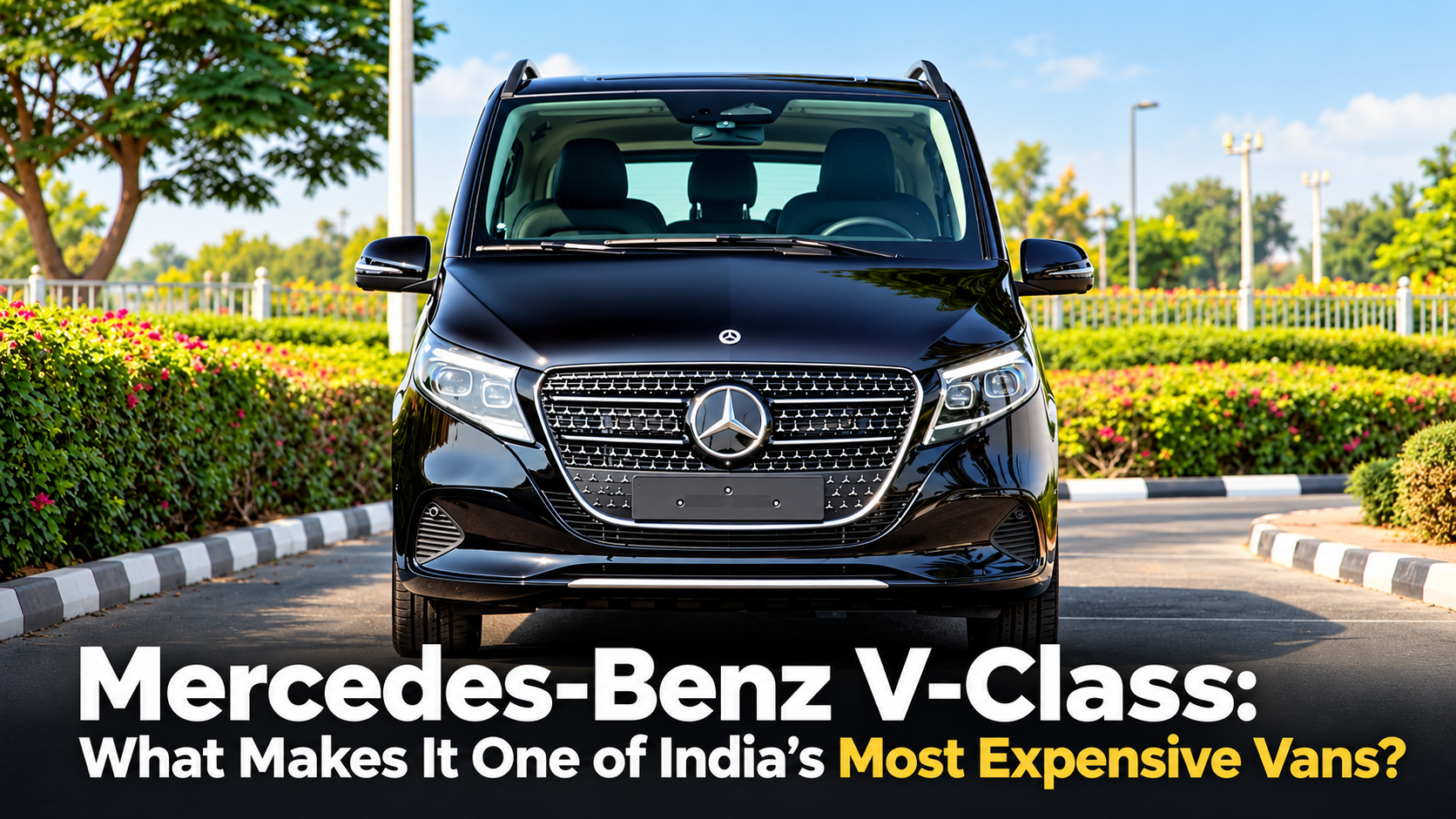
You probably think of Mercedes-Benz luxury sedans and SUVs when you think of Mercedes-Benz. What is the reason that a van-shaped passenger vehicle can cost as much as a luxury sedan or SUV? This article details the Mercedes-Benz V-Class in India: its value and appeal, its compromises, and what to look for when purchasing one.
Key Takeaways
- The V-Class is a luxury MPV focused on passenger space and comfort.
- The 2026 India launch price was ₹1.40 crore, ex-showroom; a current dealer quotation is necessary before booking.
- The Extra-Long Wheelbase configuration has a 3,430 mm wheelbase, according to Mercedes-Benz India.
- Seating configuration determines the balance between passenger comfort and luggage space.
- Luxury-MPV comparisons should match price bases, equipment and seating layouts.
- Ownership budgets should include insurance, fuel, maintenance, tyres, finance and depreciation.
- A useful demonstration includes rear-seat travel, luggage loading and parking at your regular destinations.
What Is the Mercedes-Benz V-Class, and Who Is It Designed For?
The Mercedes-Benz V-Class is a luxury premium multipurpose vehicle that prioritises the comfort and convenience of the passengers and the volume of the cargo hold. A multi-purpose vehicle (MPV) is classified as a passenger vehicle, with an emphasis on the passengers’ comfort and the cargo space, which usually accommodates the luggage of the passengers.
The owner of such a vehicle can be a family with children who use the MPV for travelling to the airport, or a businesswoman who uses the Mercedes-Benz V-Class as her personal limousine. A cargo van is considered a multipurpose vehicle as well, which serves the purpose of a cargo carrier.
The current Mercedes-Benz V-Class is available for the Indian market. It is important to note that the Mercedes-Benz V-Class 2023 is the new model, which was launched in March 2026. It is possible that the cars in good condition at used car dealerships offer different engine options, different seats, and different equipment.
[https://turbobehind.com/volvo-ex90-ev-launched-in-india-at-%e2%82%b91-26-crore-wha/]
Why is the Mercedes-Benz V-Class Important in the Luxury Market?
The Mercedes-Benz V-Class takes its place in the luxury car market by its focus on the comfort of its passengers. So, when considering a vehicle that you will spend most of your time being driven in, it may be more important to have the comfort of the vehicle’s interior come first.
For example, an executive travelling with their peers will require more than just a single comfortable set of seats. A family travelling with their grandparents, meanwhile, will be more concerned with the accessibility, seating position and the convenience of the controls.
The comfort of the passenger may also vary depending on the individual. Someone of average height will be less concerned about legroom than someone who is particularly tall. Someone with limited mobility will be more concerned with the ease of entry and exit. The showroom test drive should always be inclusive of the people who will be using the vehicle
[https://turbobehind.com/mercedes-benz-global-sales-fall-6-india-sales/]
What Is the Mercedes-Benz V-Class Price in India?
The 2026 Mercedes-Benz V-Class launched in India at ₹1.40 crore, ex-showroom, according to Autocar India’s report dated 2 March 2026. This is a historical launch price, not a confirmed current on-road quotation.
| Price-check item | Verified context |
|---|---|
| Model range | V 300 petrol and V 300 d diesel, AMG Line Extra LWB |
| Published launch price | ₹1.40 crore |
| Price basis | Ex-showroom |
| Announcement date | 2 March 2026 |
| Source | Autocar India launch report |
| Source checked | 15 October 2026 |
| Current payable amount | Obtain a dated, itemised dealer quotation |
In practice, it is the vehicle cost before registration, insurance and other on-road charges are added to it. Place and, insurance cover and optional purchases you choose will impact the on-road cost.
For instance, two customers purchasing the same car in different cities will have to pay different on-road prices. You can request a breakdown from the dealer as to what the mandatory additional charges apply to: accessories, service packages and other optional equipment.
Why Is the Mercedes-Benz V-Class So Expensive?
The V-Class’s premium positioning rests on its passenger-focused cabin, comfort equipment, engineering and luxury-brand ownership proposition. These explain what buyers receive; they do not establish Mercedes-Benz’s production costs or profit margins.
First, the Mercedes-Benz V-Class Extra-Long Wheelbase has a 3,430 mm wheelbase, according to Mercedes-Benz India. Wheelbase means the distance between the front and rear axles, which helps shape the space available for the cabin. — Source: [Mercedes-Benz India, accessed 2026]. Mercedes-Benz
For example, useful cabin space lets passengers adjust their seating position without immediately compromising another occupant’s comfort. However, a long wheelbase alone does not prove that every seating arrangement works equally well.
Which Mercedes-Benz V-Class luxury features improve rear-seat comfort?
The highlighted comfort equipment includes AIRMATIC air suspension, ventilated second-row seats with adjustable calf support, and ventilated third-row seats. Mercedes-Benz describes these features in its Indian product material; their real-world effectiveness requires a demonstration. Mercedes-Benz
| Feature | Intended passenger benefit | What to check during a demonstration |
|---|---|---|
| AIRMATIC air suspension | Adjusts suspension behaviour and vehicle level | Body movement over patched roads and speed breakers |
| Second-row ventilation | Helps manage heat at the seat surface | Cooling effectiveness after the vehicle has stood in sunlight |
| Adjustable calf support | Supports the lower legs | Whether your feet and knees remain comfortable |
| Third-row ventilation | Extends seat ventilation beyond the middle row | Airflow and control access from the actual seat |
| Long cabin | Provides scope for passenger accommodation | Legroom with every intended seat occupied |
In simple terms, air suspension uses air springs to support the vehicle. Adaptive damping adjusts how suspension movement is controlled; neither feature guarantees a comfortable response to every road surface.
For example, evaluate whether your head moves excessively over uneven patches and whether the seat remains supportive during braking. A comfort feature earns its value when it improves your regular journey.
How Do Seating, Engines and Safety Affect Everyday Use?
Seating, powertrain and safety specifications determine whether the V-Class suits your passenger count and daily routes. A vehicle that impresses with two occupants may be less convincing when loaded for a family holiday.
How many people can the India-specification V-Class seat?
Mercedes-Benz India’s current technical data lists six seats for the Extra-Long model. Launch reporting also described four-seat arrangements, so buyers considering that layout should obtain written confirmation of its current availability and approved configuration.
For example, six seats include the driver’s position. A chauffeur therefore leaves five other places, rather than six passenger places.
Importantly, usable luggage space must be assessed with the intended seats occupied. Bring your regular suitcases, stroller or mobility equipment to the demonstration instead of relying on a maximum cargo-volume figure.
For a family airport trip, set the seats to comfortable travelling positions before loading bags. Check that luggage can be secured without blocking access or requiring passengers to sacrifice necessary legroom.
Which petrol, diesel and safety specifications should buyers check?
Mercedes-Benz India lists the V 300 petrol at 170 kW/231 PS and the V 300 d diesel at 174 kW/237 PS. Its diesel specification identifies a nine-speed 9G-TRONIC automatic transmission.
The launch reports do mention mild-hybrid assistance for the petrol engine and a nine-speed auto for both engines. However, that’s not a plug-in and shouldn’t be confused with a vehicle that needs to be charged externally.
As for safety, Mercedes-Benz clearly mentions seven airbags as standard while the website specifies driver-assistance features. On the other hand, an equipment gallery can’t replace an order-specific list for what comes as standard versus optional.
Before you book, ask them to confirm the availability of the child-seat anchors, braking assistance, blind-spot monitoring and parking equipment. This guide can’t attribute an older or overseas crash-test rating to the current Indian configuration if it doesn’t apply to it.
How Does the V-Class Compare With the Toyota Vellfire and Lexus LM?
A luxury-MPV comparison involves assessing equivalent prices, seating layouts, passenger comfort, powertrains and ownership requirements. The most useful comparison starts with your regular passengers and journeys.
First, the Toyota Vellfire is a luxury people mover using a 2.5-litre petrol-hybrid system. Toyota’s Indian marketing highlights passenger amenities and identifies Hi and VIP Executive Lounge variants.
Separately, the Lexus LM 350h is a luxury hybrid MPV offered in seven-seat VIP and four-seat Ultra Luxury configurations. Choosing between those layouts changes how many people can travel together.
| Dimension | Mercedes-Benz V-Class | Toyota Vellfire | Lexus LM 350h |
|---|---|---|---|
| Dated price reference | ₹1.40 crore ex-showroom launch price, March 2026 | Approximately ₹1.20 crore Hi; ₹1.30 crore VIP Executive Lounge, online ex-showroom listings checked 15 October 2026 | Online ex-showroom listings show approximately ₹2.20 crore VIP; ₹2.75 crore Ultra Luxury, checked 15 October 2026; official indexed prices differ |
| Seating and access | Official data lists six seats; verify alternative layouts | Evaluate the chosen variant with your full passenger group | Seven-seat VIP or four-seat Ultra Luxury |
| Passenger comfort | Air suspension and highlighted rear-seat ventilation | Compare actual seat support and variant-specific amenities | Compare passenger capacity against the dedicated four-seat layout |
| Powertrain | Petrol or diesel automatic | 2.5-litre petrol hybrid | Hybrid |
| Ownership practicality | Test parking, luggage and local service support | Assess the same route, luggage load and ownership budget | Check configuration suitability and local support |
Importantly, Lexus India’s indexed official price list displays higher starting figures of ₹2,27,38,000 and ₹2,84,24,000, respectively. This discrepancy makes fresh written quotations essential; the table is indicative context, not a same-day transaction-price comparison.
Meanwhile, luxury SUVs offer a separate body-style choice. Compare a specific SUV’s access, occupied-seat luggage room and rear-seat comfort rather than assuming its price guarantees equivalent passenger accommodation.
What Ownership Costs and Practical Trade-Offs Should Buyers Consider?
V-Class ownership costs extend beyond purchase price to fuel, insurance, maintenance, tyres, finance and depreciation. Parking suitability also matters because an expensive vehicle still needs to fit your everyday surroundings.
First, Mercedes-Benz lists a length of 5,370 mm and a width of 2,249 mm with mirrors. Measure entrances, turning space and parking bays before assuming your garage is suitable.
For example, a parking bay may accommodate the body while leaving insufficient clearance for walking around it or loading luggage. Test the actual entrance and ramp with the dealer’s assistance.
Next, calculate ownership over a consistent period:
Total ownership cost = purchase and acquisition costs + finance interest + running costs − resale proceeds.
For a useful estimate, include:
- Fuel based on annual distance and realistic consumption.
- Insurance with comparable cover and deductibles.
- Scheduled servicing and exclusions from service packages.
- Tyres, wear items and unexpected repairs.
- Conservative resale assumptions.
Finally, ask what warranties and service contracts cover, including exclusions. A service package is not a guarantee that every ownership expense is included.
Which Tools and Real-Life Scenarios Help Buyers Evaluate the V-Class?
A rear-seat evaluation involves checking seat support, passenger access, ride comfort, climate control and luggage space with the intended passengers aboard. Written comparisons help prevent showroom impressions from dominating the decision.
| Buyer scenario | Main evaluation |
|---|---|
| Chauffeur-driven executive | Seat support, cabin noise and comfort during a normal commute |
| Family travelling with luggage | Child-seat installation, access and suitcase space with everyone aboard |
| Premium airport-transfer operator | Paying-passenger capacity, luggage handling, cleaning time and service downtime |
First, use official brochures and an itemised quotation checklist to record the exact vehicle, included equipment, delivery estimate and optional purchases.
Next, use a garage measurement sheet to record entrance width, overhead clearance and loading space. A tape measure and paper are sufficient.
Then, build an ownership-cost calculator in Google Sheets or the free LibreOffice Calc. Use the same ownership period, annual distance and insurance assumptions for every shortlisted vehicle.
Finally, follow a rear-seat test route covering traffic, patched surfaces, speed breakers and faster roads. Repeat the route in each alternative with comparable passenger loads.
What Should Buyers Check Before Booking a Mercedes-Benz V-Class?
Buyers should confirm the exact vehicle, test its practical suitability and obtain a complete quotation before booking.
- Confirm the model: Record the variant, engine, model year and approved seating configuration.
- Verify equipment: Separate standard features, paid options and accessories in writing.
- Test every required seat: Include family members, child seats or regular colleagues.
- Load real luggage: Keep the seats in comfortable travelling positions.
- Check parking: Test your entrance, ramp, parking bay and loading clearance.
- Obtain an itemised quotation: Include insurance, registration, optional packages and delivery terms.
- Compare alternatives: Repeat the same journey and cost calculation before deciding.
Before delivery, inspect the allocated vehicle against the agreed specification and document any discrepancies.
Conclusion: Does the V-Class Fit Your Travel Priorities?
Mercedes-Benz V-Class secures its spot in India’s luxury vehicle segment by promising to offer comfort and space to passengers in the form of a chauffeur-driven vehicle.
In the end, the buyer’s decision to purchase the Mercedes-Benz V-Class India model rests on whether the described features enhance their travel experience. The luxury MPV and the SUV can co-exist within the family, each serving its own purpose.
Therefore, it is best to pick the automobile that serves your needs and provide a solid justification and a realistic budget for the acquisition.
Written by: Sourav Ranjan, content writer covering automobiles and buyer-focused explainers.