
Summarise this blog post with: ChatGPT | Perplexity | Claude | Grok
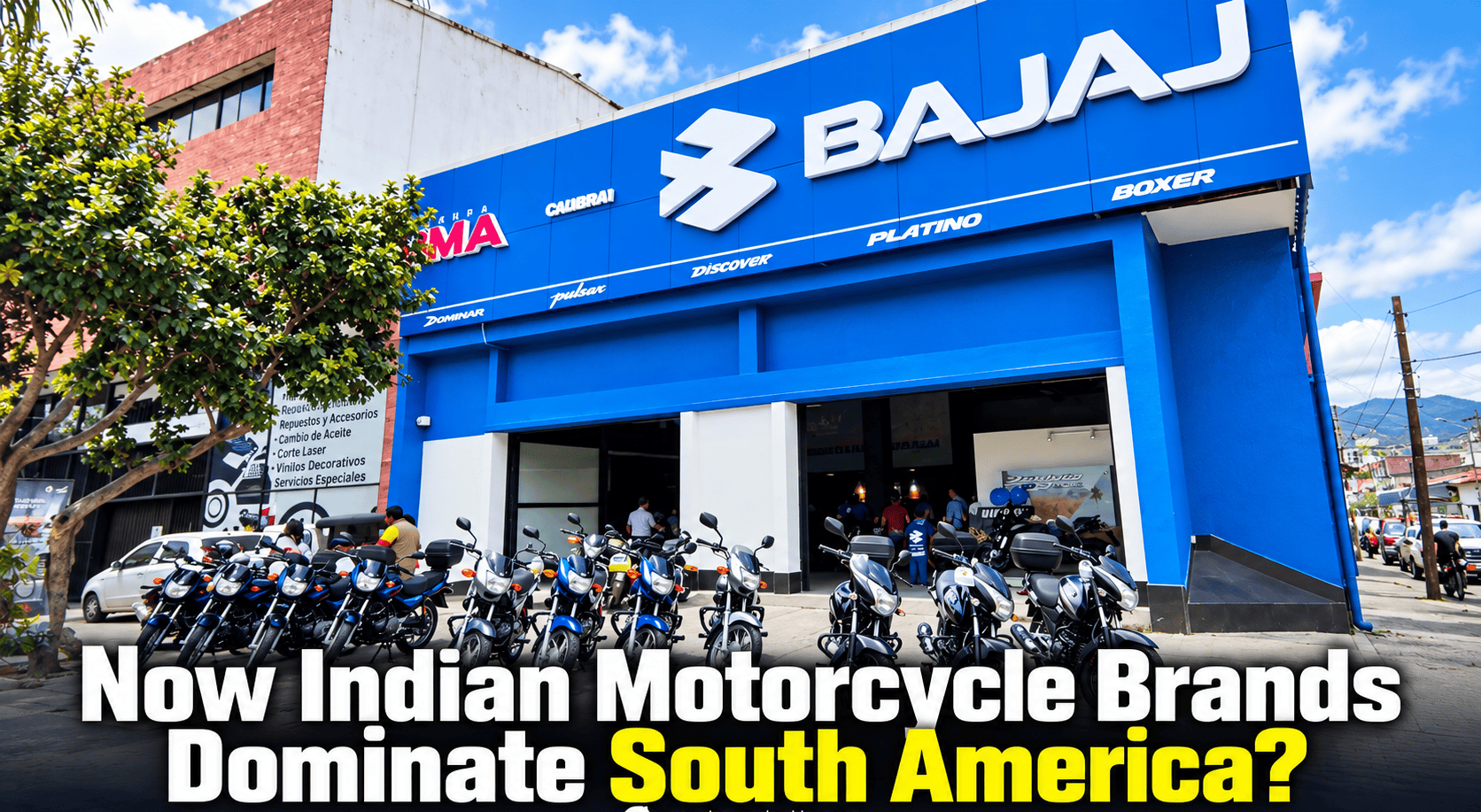
You already know Bajaj, TVS, Hero, and Royal Enfield from Indian roads. But headlines about their South American success can hide the difference between leading one market and dominating a continent. In this article, we examine Indian motorcycle brands in South America, explain their expansion strategies, and show what the evidence means for riders.
Updated: 15 October 2026. Evidence periods: Colombia, August 2026; Honda Brazil, full year 2025; Bajaj factory announcement, June 2026; local product pages checked for this article.
Key Takeaways
- Indian brands demonstrate country-specific success, but the evidence reviewed does not establish continent-wide dominance.
- Bajaj led Colombia’s new motorcycle registrations with 16.60% in August 2026. — Source: [ANDI and Fenalco, 2026].
- Honda reported more than 1.4 million Brazilian motorcycle registrations during 2025, illustrating established competitors’ scale. — Source: [Honda Brazil, 2026].
- Local assembly and distribution partnerships represent different ways to serve overseas customers.
- Market shares require matching periods, geography, and vehicle categories.
- Buyer value depends on total ownership costs, suitable products, and accessible service.
What Are Indian Motorcycle Brands in South America?
Indian motorcycle brands in South America are India-based motorcycle businesses selling their branded products in South American countries. This article examines Bajaj Auto, TVS Motor, Hero MotoCorp, and Royal Enfield, whose British heritage is distinct from its present Indian corporate ownership under Eicher Motors.
For clarity, the topic excludes the American brand called Indian Motorcycle. It also excludes Mexico and Central America from South American market calculations.
Equally, brand origin, ownership, and manufacturing location describe different things. A Bajaj assembled in Brazil remains a Bajaj, while its production contributes to Brazilian industrial activity. Royal Enfield’s Brazilian assembly operation similarly demonstrates why “Indian brand” does not mean every finished motorcycle arrives directly from India. Bajaj
[Internal link:https://turbobehind.com/bajaj-pulsar-n160-or-ns160-pricing-features-what-d/]
Why Does Indian Motorcycle Expansion in South America Matter?
Indian motorcycle expansion can be beneficial due to increased choices for customers and the potential for assembly, distribution, and servicing, such as creating another option for commuting and providing employment opportunities for mechanics and suppliers.
In Colombia, ANDI and Fenalco view motorcycles as a means of transportation and work, so apart from the effect on enthusiasts, the influx of manufacturers can impact the regular commuters and their ability to earn a living.
Furthermore, an overseas venture can also require a manufacturer to provide financing, mechanics, spare parts, and customer service.
Are Indian Motorcycle Brands Really Dominating South America?
Indian motorcycle brands show leadership in particular markets, but the reviewed evidence does not establish dominance across South America. Bajaj’s Colombian result demonstrates a specific achievement; it cannot establish the combined regional position of four separate manufacturers.
Motorcycle registration market share is a brand’s share of all new motorcycle registrations within a defined geography, reporting period, and vehicle category.
For example, the calculation is:
Brand registrations ÷ total market registrations × 100
More precisely, these descriptions measure different achievements:
- Largest individual brand: More registrations than any single rival.
- Majority share: More than half of the defined market.
- Segment leadership: First place within a category, such as a displacement class.
- Sales growth: An increase compared with an earlier period.
Crucially, growth measures change; market share measures position. A brand can grow rapidly from a small base while remaining behind established competitors.
Where Do Indian Brands Lead—and Where Is Evidence Limited?
Colombia provides verified evidence of Bajaj’s monthly leadership, while Brazil illustrates the strength of established competition. Comparing motorcycle brands across countries involves matching registration periods and vehicle categories before calculating or comparing market shares.
| Country | Reporting period | Metric | Brand result | Source | What the result establishes |
|---|---|---|---|---|---|
| Colombia | August 2026 | New motorcycle registration share | Bajaj: 16.60%, first place | ANDI/Fenalco, 2026 | Monthly national brand leadership |
| Brazil | January–December 2025 | Motorcycle registrations | Honda: more than 1.4 million | Honda Brazil, January 2026 | Substantial incumbent scale |
| Brazil | June 2026 announcement | Annual factory capacity | Bajaj: up to 48,000 motorcycles | Bajaj Brazil, 2026 | Industrial capacity, not customer registrations |
Sources: ANDI/Fenalco, Honda Brazil, and Bajaj Brazil. These rows provide context, not a like-for-like ranking.
What Do Colombia’s Motorcycle Registrations Reveal About Bajaj?
Bajaj accounted for 16.60% of Colombia’s new motorcycle registrations in August 2026, ranking first among brands, according to ANDI and Fenalco. The country recorded 111,896 new motorcycles that month. — Source: [ANDI and Fenalco, 2026].
However, first place does not mean most buyers selected Bajaj. Its reported share remained well below a majority, and the association also named AKT and Suzuki among the leading brands.
For readers, the useful question is whether leadership persists across comparable periods. A monthly result offers a snapshot; a year-to-date series shows whether the position is sustained.
How Strong Are Indian Motorcycle Brands in Brazil?
Indian brands have an established presence and expanding operations in Brazil, alongside a powerful Japanese incumbent. Honda recorded more than 1.4 million motorcycle registrations in Brazil during 2025, according to Honda Brazil’s January 2026 results announcement.
Additionally, Honda reported 14% registration growth in 2025 and 1,100 sales points in its results announcement. — Source: [Honda Brazil, 2026]. These manufacturer-reported figures indicate substantial commercial reach.
Nevertheless, Honda’s annual volume cannot be directly compared with Bajaj’s Colombian monthly percentage. This review also lacks a harmonized registration dataset covering Argentina, Peru, Chile, and the remaining South American markets. Missing coverage prevents a defensible continental market-share calculation.
Which Indian Motorcycle Brands Sell in South American Countries?
Bajaj, TVS, Hero, and Royal Enfield have verified offerings in the countries examined here, but their product and distribution strategies differ. The following examples establish specific market presence, not exhaustive country coverage.
- Bajaj: Brazil’s range includes Pulsar and Dominar models, supported by its own subsidiary and local assembly. Its published October 2026 cash offer lists the Dominar NS160 at R$19,500, subject to stock and promotional conditions. — Source: [Bajaj Brazil, 2026]. Bajaj
- TVS: Colombia’s Auteco website offers the Raider 125 FI through its sales and support operation. This positions TVS within the small-displacement urban motorcycle category. Sitio Oficial Auteco
- Hero: Colombia’s catalogue separates work motorcycles, urban Hunk models, scooters, and dual-purpose Xpulse products. HMCL Colombia also has a manufacturing base in Villa Rica. Urbanas
- Royal Enfield: Brazil’s official catalogue includes the Hunter 350, while the company has announced a Manaus assembly operation. Its middleweight offering addresses a different shortlist from basic work motorcycles. royalenfield.com
Importantly, the reviewed evidence does not establish comparable registration shares for TVS, Hero, and Royal Enfield. Product availability proves presence, not leadership.
Which Established Motorcycle Brands Compete With Indian Manufacturers?
Established competitors include Japanese manufacturers, Chinese-linked businesses, and locally rooted brands. In Colombia, Suzuki appears among the leading brands in the cited registration report; in Brazil, Honda’s results demonstrate substantial scale.
Meanwhile, AKT describes itself as a Colombian brand assembling motorcycles with materials sourced from several countries. Shineray’s Brazilian catalogue provides another competitive example, including urban scooters. Brand nationality alone does not describe a motorcycle’s supply chain or ownership experience.
How Do Indian Motorcycles Compare With Japanese and Other Competitors?
Indian motorcycles should be compared with competing local models across registrations, price, suitability, support, and production presence. A fair comparison matches the country, intended use, and approximate motorcycle category.
How Should Registration Share Be Compared?
Registration comparisons require the same market and time window. Compare Colombian brand registrations within one monthly or year-to-date report. Do not combine an Indian manufacturer’s global exports with a Japanese competitor’s Brazilian retail registrations.
For a combined Indian-brand share, first define the included brands. Then sum their registrations and divide by the matching market total. Averaging country percentages does not produce regional market share.
How Should Purchase Prices Be Compared?
Purchase-price comparisons require dated local quotations with equivalent inclusions. Colombia’s Hero Hunk 125R and TVS Raider 125 FI provide a useful same-country, small-displacement example.
| Item | Hero Hunk 125R | TVS Raider 125 FI |
|---|---|---|
| Market | Colombia | Colombia |
| Category | 125-class urban motorcycle | 125-class urban motorcycle |
| Advertised price checked | From COP 7,090,000 | COP 8,199,999 |
| Price qualification | Catalogue identifies 2027 models; registration and insurance excluded | Price varies by version, colour, and city; registration and SOAT excluded |
| Buyer action | Confirm promotion and exact specification | Confirm model year and exact specification |
Prices checked for this article on 12 October 2026. — Source: [Hero Colombia and Auteco, 2026]. These are advertised prices, not matched final dealer quotations.
How Should Product Suitability Be Compared?
Product suitability measures how well a motorcycle fits the rider’s actual journeys. A commuter may prioritize manageable weight and manoeuvrability; a recreational rider may prioritize seating comfort and highway performance.
For example, comparing a Hunter 350 with a basic work motorcycle solely by price ignores their different purposes. Test the intended model with realistic passenger, luggage, and road requirements.
How Do Dealer Networks and Spare Parts Influence Ownership?
Dealer networks influence maintenance access, while parts availability influences repair delays. A delivery rider should ask about locally stocked brake pads, filters, cables, and accident-repair components.
Equally, a long warranty does not guarantee quick repairs. Ask the workshop for service booking times, parts lead times, and written warranty conditions. Service access is local, even when a brand is global.
How Should Local Production Be Compared?
Local production should be assessed through operational activity, not announcement size alone. An operating assembly line demonstrates industrial presence; its rated capacity does not establish customer demand.
Similarly, assembling locally does not automatically prove lower prices or greater reliability. Compare actual dealer quotations, maintenance requirements, and documented customer support.
Why Do Motorcycle Manufacturers Invest in Local Assembly?
Local assembly allows manufacturers to organize production closer to the market they serve. Depending on the operation, it can support supply planning, local employment, and responsiveness to demand.
Specifically, Bajaj’s Manaus factory had annual production capacity of up to 48,000 motorcycles, according to the company’s 25 June 2026 announcement. Bajaj reported that the facility operated using CKD, or completely knocked-down component kits. — Source: [Bajaj Brazil, 2026]. Bajaj
For clarity, the main measures are distinct:
| Measure | What it records |
|---|---|
| Exports | Vehicles or components shipped internationally |
| Production | Motorcycles manufactured or assembled |
| Capacity | Potential output under specified operating conditions |
| Registrations | Vehicles entered into the relevant registration system |
Consequently, capacity is not output, and output is not registrations. Inventory and delivery timing can separate all three.
Which Tools Help Buyers Evaluate Motorcycle Brands?
Official product pages, dealer locators, maintenance schedules, and registration reports help buyers evaluate both Indian brands and their competitors. Use market reports to assess commercial performance and model documents to assess ownership requirements.
First, use this checklist:
- Choose the exact local version. Confirm model year, braking equipment, and warranty.
- Request a written total price. Include registration, insurance, delivery, and financing charges.
- Check workshop access. Confirm travel distance and appointment availability.
- Price common replacements. Ask about tyres, filters, brake components, and chain sets.
- Calculate ownership costs. Include fuel, servicing, finance costs, and estimated resale value.
For example, build a worksheet in a free spreadsheet such as Google Sheets or LibreOffice Calc:
Ownership cost = purchase price + finance charges + fuel + maintenance + insurance and fees − resale proceeds.
Importantly, keep every input in the same local currency and label estimates. Fuel costs should use expected distance, realistic consumption, and a dated local pump price.
Which Figures Should Readers Track Next?
Comparable year-to-date registrations, market-share changes, and operational service expansion provide the clearest next checks. For example, compare each brand’s January–August registrations with the same period a year earlier.
Next, distinguish completed developments from plans. A functioning workshop, an available replacement part, or an operating assembly line provides stronger practical evidence than an announced target.
For buyers, choose according to use:
- Commuters: Comfort, manageable running costs, and nearby servicing.
- Delivery riders: Downtime, consumables, and commercial-use warranty conditions.
- Recreational riders: Route suitability, luggage options, and support beyond home.
Conclusion: What Does the Evidence Say?
Indian motorcycle brands are achieving meaningful South American success, but continent-wide dominance remains unproven by the evidence reviewed. Bajaj’s Colombian leadership is specific and measurable; Brazil demonstrates why broader claims need more complete data.
Ultimately, different manufacturers serve complementary rider needs. Compare countries, periods, models, and ownership conditions—and you will understand the industry more accurately than any “taking over” headline allows.
Written by: Sourav Ranjan, content writer. This article examines automotive market evidence and practical motorcycle ownership considerations.