
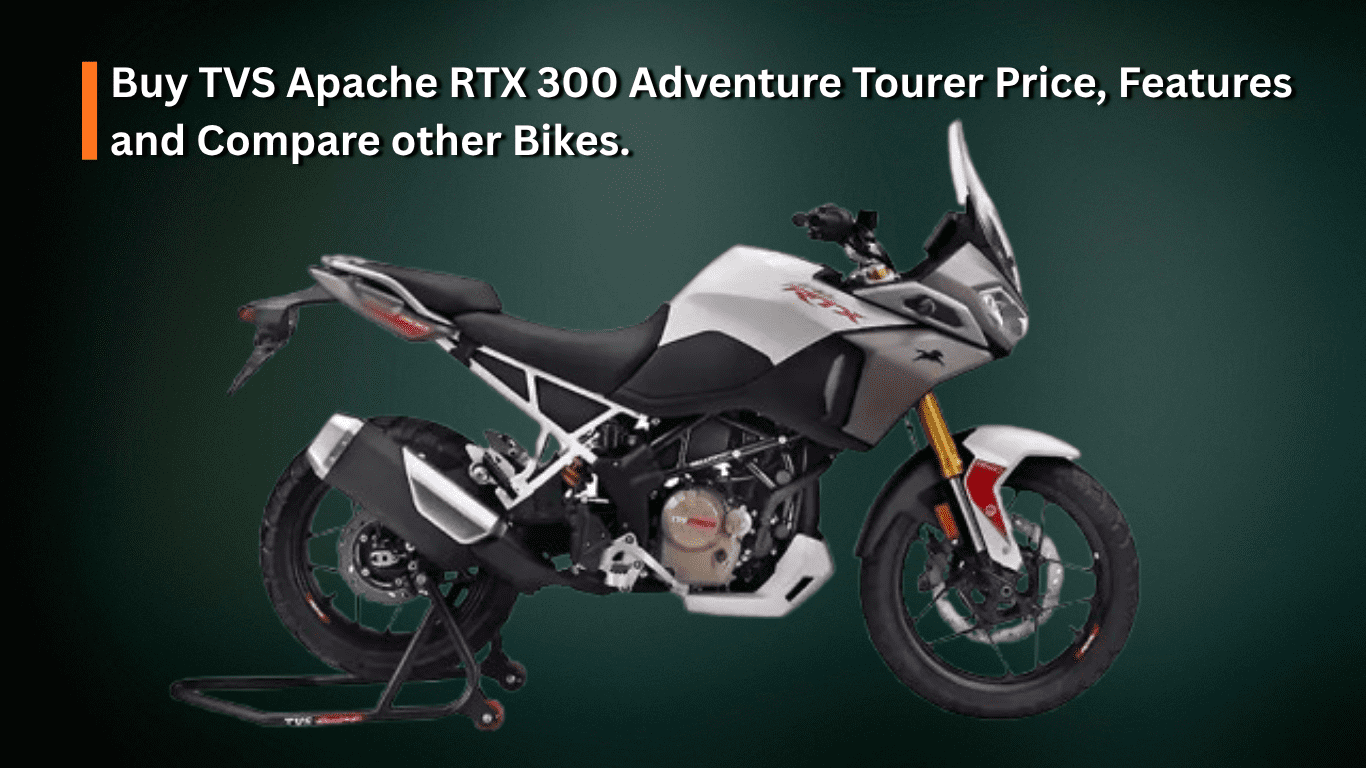
For years, TVS dominated India’s street and entry-level performance motorcycle space with the Apache series. But adventure touring remained outside its reach. That changes with the Apache RTX 300. The question now is not whether TVS can build an adventure bike — but whether the RTX 300 is good enough to challenge established names like KTM, Suzuki, and Yezdi.
Adventure motorcycles are no longer niche products in India. Riders want machines that can survive broken roads, cruise comfortably at highway speeds, and still be practical enough for daily commuting. The RTX 300 enters this space promising performance, features, and affordability. But does it truly deliver, or is it simply TVS trying to catch up?
Table of Contents
Is the Price Truly Competitive, or Just Looks Good on Paper?
TVS has launched the Apache RTX 300 at ₹1.99 lakh (ex-showroom), with the fully equipped variant reaching ₹2.29 lakh. On paper, this looks aggressive. It undercuts some competitors while offering similar or better specifications. But real-world ownership tells a slightly different story.
Once insurance, registration, and taxes are included, the on-road cost climbs quickly. In Delhi, the base model already crosses ₹2.28 lakh, while higher variants approach ₹2.6 lakh. This raises an important question: Is the RTX 300 still affordable, or is it simply priced to attract attention? The answer lies in what it offers in return.
Does the Engine Deliver Real Performance, or Just Good Numbers?
The RTX 300 is powered by a new 299.1cc liquid-cooled engine producing around 36 PS and 28.5 Nm of torque. These numbers put it ahead of many 250cc rivals. But raw numbers alone don’t define riding experience.
What matters more is how usable that power feels. Early impressions suggest the engine is tuned for flexibility rather than aggression. This means smoother highway cruising, easier overtaking, and less stress on the engine during long rides. The inclusion of a 6-speed gearbox and slipper clutch further improves usability. In real-world riding, this matters far more than peak horsepower.
Can the Suspension and Chassis Handle Indian Roads?
Adventure motorcycles are judged heavily on their suspension quality. Indian roads, with their unpredictable surfaces, demand strong suspension systems. The RTX 300 uses USD front forks and a rear mono-shock setup mounted on a trellis frame. This configuration suggests TVS is aiming for a balance between comfort and control. It may not be designed for extreme off-road riding, but it appears well-suited for highway touring and poor road conditions, which is exactly what most Indian riders face. This makes the RTX 300 more practical than motorcycles designed purely for off-road enthusiasts.
Are the Electronics Useful, or Just Marketing Add-Ons?
Modern motorcycles increasingly rely on electronics to enhance safety and comfort. The RTX 300 includes traction control, ride modes, cruise control, and a TFT display with smartphone connectivity.
Cruise control, in particular, is rare at this price point. For riders covering long highway distances, it significantly reduces fatigue. However, electronics come with trade-offs. More complexity means more potential maintenance challenges over time. Whether this becomes a real issue will depend on TVS’s long-term reliability.
Does It Actually Work as a Touring Motorcycle?
Touring capability depends heavily on rider comfort, not just performance. The RTX 300 offers an upright seating position, wide handlebars, and wind protection, all essential for long-distance riding.
These factors reduce rider fatigue and improve overall comfort. However, the tall seat height may make it less accessible for shorter riders, especially in city traffic. At around 180 kg, the bike remains manageable, but beginners may need time to adjust.
How Does It Compare to KTM, Suzuki, and Yezdi?
This is where things become more interesting, as KTM has strong off-road credibility and proven performance. Suzuki offers excellent reliability. Yezdi focuses heavily on rugged terrain capability.
The RTX 300 doesn’t dominate any single category completely. Instead, it focuses on balance, offers more features than Suzuki, more comfort focus than KTM, and more road usability than Yezdi. This balanced approach may actually be its biggest strength.
Is This the Right Bike for Most Indian Riders?
This depends on what the rider actually needs. If someone wants extreme off-road performance, there are better choices. But most Indian riders don’t spend their weekends climbing mountains or riding through forests.
They commute, travel on highways, and occasionally explore rough roads. For the majority, the RTX 300 makes sense as it offers versatility rather than specialization.
The Bigger Question: Can TVS Be Trusted in the Adventure Segment?
TVS has strong experience building reliable motorcycles. But the adventure segment is new territory. The RTX 300 is not just a motorcycle; it is a test of TVS’s ability to compete in a more demanding category.
Success will depend not just on specifications, but on reliability, service support, and long-term ownership experience. Fortunately, TVS’s extensive service network gives it an advantage over smaller competitors.
Wrapping it up
The Apache RTX 300 doesn’t try to be the most powerful, the most off-road capable, or the cheapest. Instead, it tries to be practical. It offers enough performance, enough comfort, and enough features to satisfy most riders. It may not immediately replace established leaders, but it represents a serious and credible entry into the adventure motorcycle segment. For riders who want a single motorcycle capable of daily use and long-distance travel, the RTX 300 is not just an option; it is a meaningful new contender.
Q 1: What is the expected on-road price of TVS Apache RTX 300 in major cities?
Answer:
The ex-showroom price starts at ₹1.99 lakh, and for the top variant goes up to ₹2.29 lakh. The on-road price in cities like Delhi, Mumbai, and Bangalore is expected to fall between ₹2.30 lakh to ₹2.55 lakh, depending on insurance, RTO charges, and accessories.
Q 2: How does the TVS Apache RTX 300 compare to the KTM 250 Adventure?
Answer:
The RTX 300 offers:
Higher power output (~36 PS vs KTM’s ~31 PS)
Better pricing
More electronics like cruise control, multiple riding modes, and traction control
However, the KTM 250 Adventure has a stronger off-road legacy and better suspension travel. For touring and features, the RTX 300 gives better value.
Q 3: Is the Apache RTX 300 suitable for long-distance touring?
Answer:
Yes. The RTX 300 is designed for touring with:
Upright riding posture
Cruise control
Windshield protection
TFT console with navigation
Strong mid-range torque
Comfortable suspension
These features make it ideal for highway rides and weekend adventures.