
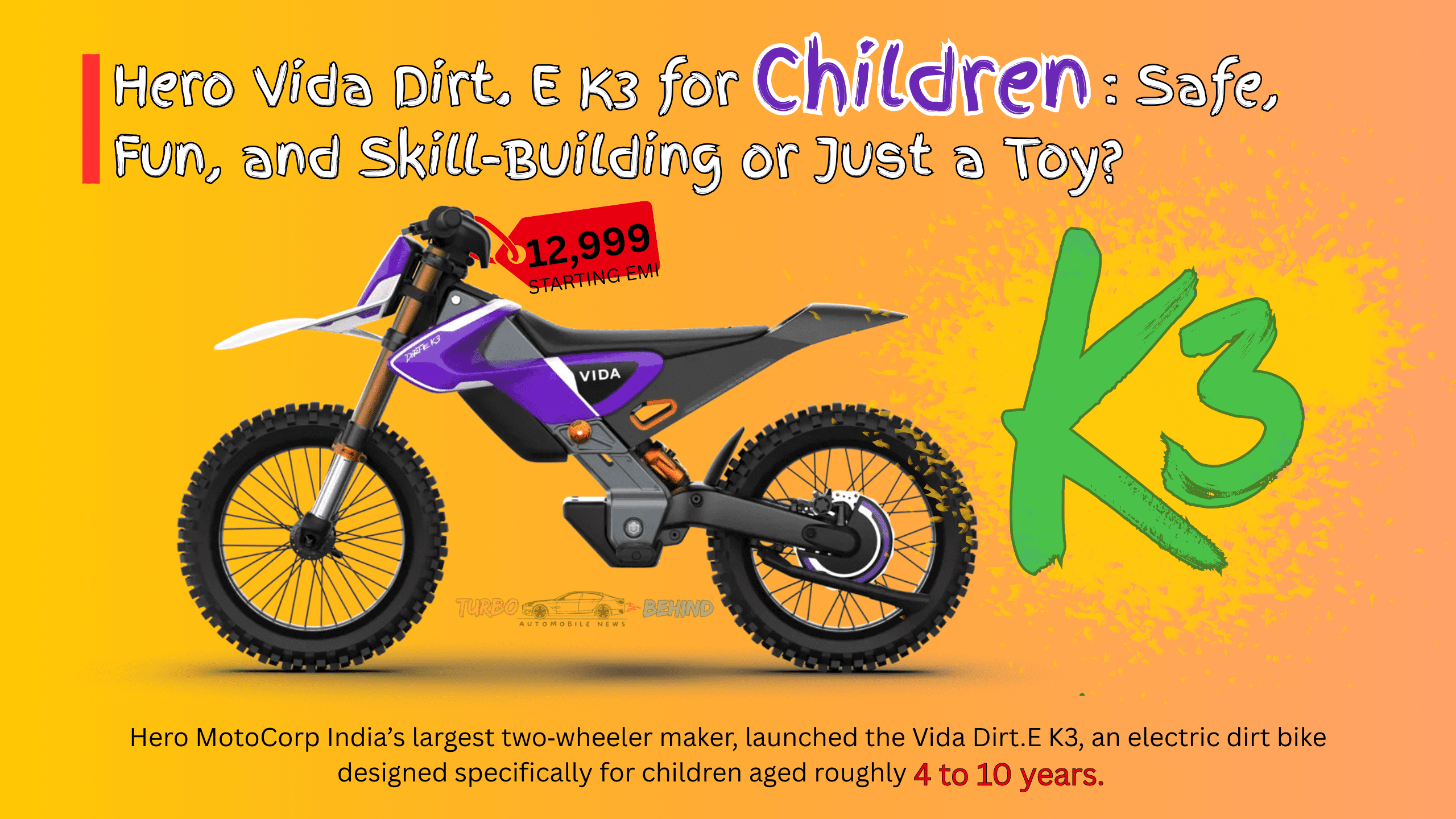
Hero MotoCorp has spent decades putting India on two wheels. From the humble Splendor to its newer Vida electric scooters, its mission has always been simple: practical mobility for the masses. But with the launch of the Vida Dirt.E K3 electric dirt bike for children, Hero isn’t solving a mobility problem. It’s creating an entirely new category—and taking a gamble while doing so.
This isn’t transportation. It’s not commuting. It’s not even necessary.
So why did Hero build it?
Is the Dirt.E K3 a serious training machine designed to build future riders—or is it a premium novelty product aimed at a small, urban niche?
The answer isn’t as straightforward as Hero’s marketing would suggest.
What Exactly Is the Dirt.E K3? And Who Actually Needs It?
Let’s be clear about one thing: the Dirt.E K3 isn’t a toy in the traditional sense. It’s a scaled-down electric motorcycle, complete with real throttle control, real braking hardware, and real riding dynamics.
Unlike battery-powered toy bikes that simulate motion, this machine delivers actual riding experience. Children aged roughly 4 to 10 can learn throttle control, braking balance, and riding posture—the same core skills required for full-sized motorcycles later in life.
But here’s the uncomfortable truth: India never had a widespread need for this category.
Most riders in India learned on bicycles, borrowed scooters, or small commuter motorcycles. That system worked. It produced millions of skilled riders without requiring ₹70,000 training machines.
So the Dirt.E K3 isn’t solving an existing problem. It’s introducing a new idea entirely.
Whether Indian buyers embrace that idea is uncertain.
Performance and Power: Sensibly Limited or Underwhelming?
The Dirt.E K3 uses a modest electric motor producing 350W continuous and 500W peak output. On paper, these numbers sound insignificant. But they’re deliberately limited.
Hero isn’t chasing performance—it’s chasing control.
Top speed varies depending on riding mode:
- Beginner mode: approximately 7 km/h
- Amateur mode: approximately 16–17 km/h
- Pro mode: approximately 23–25 km/h
These speeds are slow enough to minimize injury risk while still delivering excitement.
Critics might call it underpowered. But that criticism misunderstands the purpose.
This isn’t about speed. It’s about skill development.
Still, parents spending ₹70,000 may question whether this level of performance justifies the price.
Battery and Charging: Convenient, But Nothing Revolutionary
The removable 360 Wh lithium-ion battery provides approximately 2–3 hours of riding time. Charging takes around three hours using a standard household outlet.
The removable design is genuinely practical. Parents don’t need dedicated EV charging infrastructure.
But let’s not exaggerate the innovation here. Removable batteries already exist in multiple EV products.
This is convenient, not revolutionary.
Safety Features: Necessary, But Do They Solve Parents’ Biggest Concern?
Hero has clearly prioritized safety.
The Dirt.E K3 includes:
- Magnetic kill switch that shuts off power instantly if the rider falls
- Hydraulic braking system
- Protective motor casing
- Adjustable ride modes
These features reduce risk. They do not eliminate it.
Children can still fall. Injuries can still happen.
For many parents, the core hesitation isn’t technology—it’s trust.
Trust in the product. Trust in their child’s ability. Trust in the environment where it will be used.
No amount of engineering can fully solve that psychological barrier.
Price: The Dirt.E K3’s Biggest Strength—or Its Biggest Weakness?
At ₹69,990, the Dirt.E K3 costs more than many adult bicycles—and even some entry-level commuter motorcycles.
This raises an unavoidable question:
Is this a necessity—or a luxury indulgence?
For many Indian families, spending this much on a product that children will eventually outgrow may feel difficult to justify.
Yes, the adjustable design extends usability. Yes, the engineering quality is high.
But perception matters more than engineering in market success.
And perception will define whether this product succeeds or fails.
Cultural Reality: India Isn’t Australia or Europe
In countries like Australia and parts of Europe, child-focused dirt bikes are part of a larger motorsport culture.
India doesn’t have that ecosystem.
There are few dedicated dirt tracks. Few structured training programs. Few environments where children can safely use such machines regularly.
Without infrastructure, ownership becomes limited to occasional use.
This reduces perceived value.
Strategic Motive: Is Hero Building a Product—or Building Future Customers?
Viewed purely as a product, the Dirt.E K3 faces obvious market limitations.
Viewed strategically, however, its purpose becomes clearer.
Hero isn’t just selling bikes. It’s building brand loyalty early.
A child who learns riding on a Hero electric bike today may become a Hero EV customer tomorrow.
This isn’t about immediate profits. It’s about long-term positioning.
And from that perspective, the Dirt.E K3 makes strategic sense—even if sales volume remains limited.
The Bigger Question: Is This the Future—or Just an Experiment?
The Dirt.E K3 represents something larger than itself.
It represents the beginning of a shift—from mobility products built purely for necessity to mobility products built for experience.
As India becomes wealthier and EV adoption increases, niche categories like this may grow.
But that future isn’t guaranteed.
Hero is betting on a cultural shift that hasn’t fully happened yet.
Whether that bet pays off remains uncertain.
Wrapping It Up: The Dirt.E K3 Isn’t Essential—But It Might Be Important
The Hero Vida Dirt.E K3 isn’t a product India urgently needed. It doesn’t solve a widespread transportation problem. It doesn’t improve daily mobility. And for most families, it won’t be a practical purchase.
But its importance lies elsewhere.
It introduces children to electric mobility early. It builds riding skills safely. It expands Hero’s EV ecosystem into new territory.
Its success won’t be measured by sales volume alone. It will be measured by influence—by whether it helps normalize electric mobility for future generations.
For now, the Dirt.E K3 remains a niche product aimed at a specific audience.
Not essential. Not mass-market.
But undeniably forward-thinking.
And sometimes, that’s how new categories begin.