
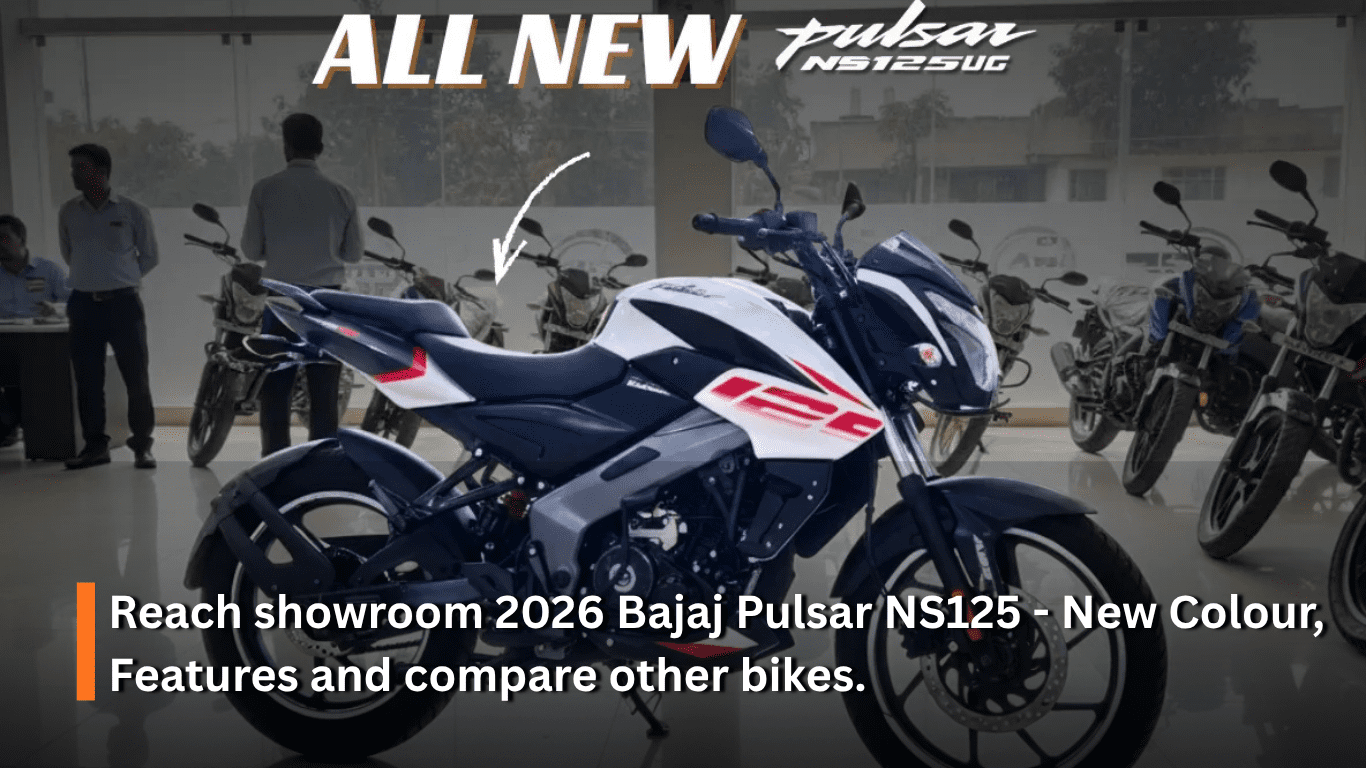
Bajaj has quietly begun sending the 2026 Pulsar NS125 to dealerships across India. There hasn’t been a dramatic launch event or aggressive marketing push. Instead, the updated model is gradually appearing in showrooms, bringing new colours, updated console features, and subtle refinements.
But this raises an important question: is the 2026 Pulsar NS125 actually improved in meaningful ways, or is this simply Bajaj keeping the model alive in an increasingly competitive 125cc segment? With rivals like the TVS Raider 125 and Hero Xtreme 125R pushing the boundaries of features and design, Bajaj cannot afford to let the NS125 fall behind.
Table of Contents
What Does “Reached Showrooms” Really Mean for Buyers?
When manufacturers say a motorcycle has “reached showrooms,” it doesn’t always mean a full redesign or immediate nationwide availability. It usually means updated units are being gradually delivered to dealers. Some cities may already have display and test ride models, while others may still be selling older stock.
For buyers, this matters. Walking into a showroom today could mean choosing between older and newer versions of the same motorcycle. Unless you specifically ask for the 2026 version, you might not get the latest update. This makes it important to verify exactly which version the dealer is offering.
What Has Actually Changed in the 2026 Pulsar NS125?
At first glance, the update focuses heavily on appearance and digital features rather than mechanical changes. The most visible upgrade is the introduction of a new Pearl Metallic White colour option, combined with subtle accent detailing. This gives the bike a fresher and slightly more premium look. While colour changes alone don’t affect performance, they do influence buyer perception, especially among younger riders, who often prioritize design. Bajaj has also retained its bold colour lineup, which continues to be one of the NS125’s strongest visual selling points.
Is the Digital Console Upgrade a Real Improvement or Just a Trend?
One of the more meaningful changes comes in the form of a fully digital instrument cluster with navigation support and smartphone connectivity. This is not just cosmetic; turn-by-turn navigation can be genuinely useful, especially for riders who use their motorcycles for daily commuting or longer rides.
However, this also raises a broader question: are features becoming more important than mechanical improvements? While connectivity enhances convenience, it doesn’t improve acceleration, braking performance, or ride comfort. Buyers must decide whether digital features justify choosing one bike over another.
Selectable ABS Modes: Useful Innovation or Limited Benefit?
The updated NS125 introduces selectable ABS modes; Rain, Road, and Off-road. This sounds impressive, especially in a 125cc motorcycle But the reality is more complicated. The bike still uses single-channel ABS, meaning only the front wheel has ABS protection. The rear wheel remains without ABS intervention.
While adjustable ABS modes provide some customization, they don’t replace the safety benefits of dual-channel ABS, which is now becoming more common even in smaller motorcycles. This leaves the NS125 in an interesting position: technologically improved, but still not fully class-leading in safety.
What Hasn’t Changed: Engine and Core Performance Remain the Same
Perhaps the most important detail is what Bajaj hasn’t changed. The NS125 continues to use the same 124cc air-cooled engine producing around 12 PS of power and approximately 11 Nm of torque.
This engine has always been reliable and efficient. It offers decent performance for city use and occasional highway riding But it also means there’s no real performance improvement in the 2026 version. Acceleration, top speed, and overall riding experience remain largely identical to the previous model. This makes the update evolutionary rather than revolutionary.
Price Expectations: Will the Update Affect Affordability?
Previous versions of the Pulsar NS125 were priced between ₹91,000 and ₹96,000 ex-showroom. With added features and new colour options, a slight price increase is expected. On-road pricing in major cities will likely fall between ₹1.05 lakh and ₹1.20 lakh.
This keeps the NS125 within reach of students, young professionals, and first-time buyers — which has always been its core audience. However, buyers will inevitably compare it with competitors offering similar or better features.
Can the NS125 Still Compete With the TVS Raider 125 and Hero Xtreme 125R?
This is where things become more competitive. The TVS Raider 125 has already set a strong benchmark in this segment, offering excellent performance, modern features, and strong styling. The Hero Xtreme 125R, meanwhile, focuses on aggressive design and refinement.
The NS125’s advantage lies in its Pulsar branding, sharp streetfighter styling, and balanced performance. The addition of navigation and ABS modes helps it stay relevant, but it doesn’t completely leap ahead of rivals. Instead, it remains one of several strong options rather than the undisputed leader.
Who Should Actually Consider Buying the 2026 Pulsar NS125?
The NS125 makes the most sense for buyers who want a balance between sporty design, daily usability, and affordability.
It is particularly suitable for:
- College students
- First-time motorcycle buyers
- Daily commuters
- Riders upgrading from smaller commuter bikes
However, buyers looking for major performance improvements may find little difference compared to the previous version. This update focuses more on experience and usability rather than raw performance.
The Bigger Question: Is This Enough to Keep the NS125 Relevant?
The 125cc segment in India is evolving rapidly. Buyers now expect not just reliability and mileage, but also features, safety, and modern design. The 2026 update ensures the Pulsar NS125 does not fall behind.
But it also highlights a broader industry trend: manufacturers are prioritizing technology and visual appeal while keeping mechanical platforms largely unchanged. Whether this approach is enough to maintain long-term competitiveness remains to be seen.
Wrapping it up
The 2026 Bajaj Pulsar NS125 update is not a dramatic transformation. Instead, it is a careful, strategic refresh. It improves the ownership experience through better technology, updated styling, and improved usability, without fundamentally changing the motorcycle. For new buyers entering the 125cc segment, it remains a strong and sensible option.
But for existing owners, the upgrade may not be compelling enough to justify switching.Ultimately, the NS125 continues to do what it has always done well: offer sporty looks, reliable performance, and practical everyday usability at an accessible price.
Q 1: What is the expected on-road price of the 2026 Bajaj Pulsar NS125?
Answer:
The expected ex-showroom price for the Pulsar NS125 is around ₹95,000 to ₹1.05 lakh.
The on-road price in major cities like Delhi, Mumbai, Pune, and Bengaluru is likely to fall between ₹1.10 lakh to ₹1.20 lakh, including insurance, RTO, and handling charges.
Q 2: Which bikes will compete with the 2026 Pulsar NS125?
Answer:
The Pulsar NS125 will directly compete with:
TVS Raider 125
Hero Xtreme 125R
Honda SP 125
TVS Radeon (top variants)
Honda Shine 125 (disc variant)
In terms of features and sporty styling, the TVS Raider and Xtreme 125R are its strongest rivals.
Q 3: Is the Pulsar NS125 a good option for students and daily commuters?
Answer:
Yes, the NS125 is ideal for:
College students who want a stylish yet affordable bike
Daily commuters needing good mileage (expected 50–55 kmpl)
Urban riders who prefer light handling and low maintenance
First-time bike buyers looking for performance and features at budget pricing
With new color options, sporty design, and modern features, it’s a practical and stylish everyday bike.