
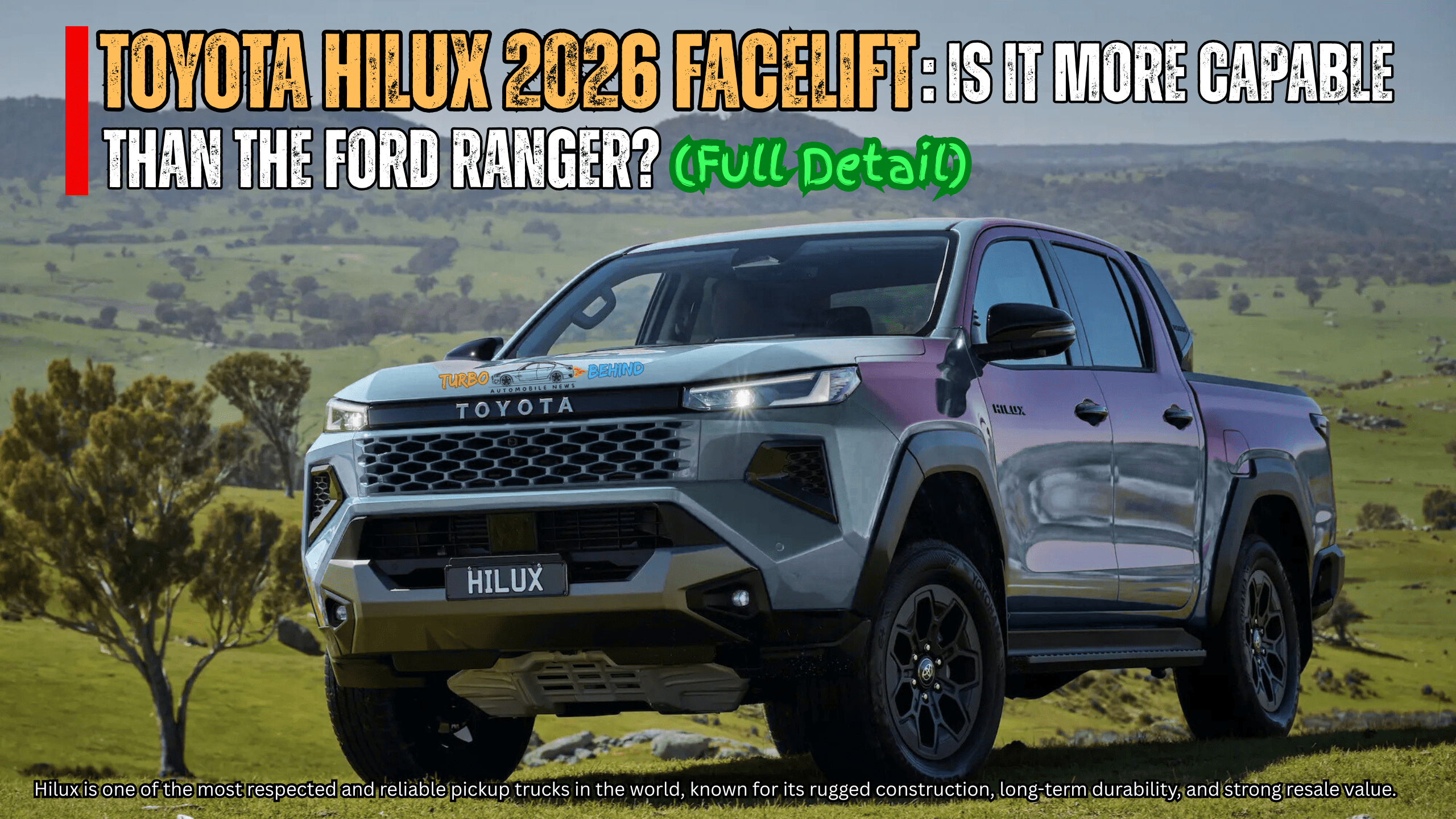
For decades, the Toyota Hilux has carried a reputation that few vehicles in the world can match. It isn’t just known as a pickup truck—it’s known as the pickup truck that refuses to die. From war zones to deserts, farms to construction sites, the Hilux earned its credibility through abuse, not advertising.
But here’s the uncomfortable truth Toyota now faces: durability alone may no longer be enough.
With the arrival of the 2026 Toyota Hilux facelift, Toyota isn’t just refreshing an old icon; it’s defending it. Because competitors like the Ford Ranger, especially in its latest generation, have changed expectations. Buyers no longer want pickups that are simply tough. They want pickups that are tough, comfortable, technologically advanced, and future-ready. The Hilux still dominates in reputation. But reputation doesn’t automatically win the future.
Exterior Design: Modernization or Desperation to Stay Relevant?
The upcoming facelift introduces a redesigned front grille, sharper LED headlights, and revised bumpers. On paper, this sounds like a standard mid-cycle update.
But look closer, and the intent becomes obvious.
Toyota isn’t trying to reinvent the Hilux—it’s trying to keep it visually competitive. Because vehicles like the Ford Ranger and even newer rivals from China have pushed pickup design into more aggressive, premium territory.
The Hilux’s traditional strength was function-first design. But today’s buyers want presence. They want something that looks as good outside a hotel as it does on a worksite.
Toyota understands this. The facelift is less about aesthetics—and more about perception.
Interior Upgrades: Finally Addressing Hilux’s Biggest Weakness?
Historically, the Hilux cabin was never its strongest point. It was functional, durable, and reliable—but rarely luxurious.
That approach worked when buyers prioritized durability above everything else.
But today’s pickup buyers expect more.
The facelift introduces:
- Larger touchscreen infotainment system
- Digital instrument cluster in higher trims
- Wireless smartphone connectivity
- Improved cabin materials
- Better sound insulation
These upgrades aren’t optional anymore—they’re necessary.
Because competitors like the Ford Ranger have transformed pickup interiors into near-SUV environments.
Toyota isn’t setting new standards here. It’s catching up.
Engine and Performance: Still Strong, But No Longer Untouchable
The Hilux will continue using its proven 2.8-litre turbo diesel engine producing around:
- 204 PS of power
- Up to 500 Nm of torque
These figures remain competitive. This engine delivers excellent towing capability, strong off-road performance, and proven durability. But here’s the real question: is “proven” enough?
The Ford Ranger offers similar or better performance with newer engine technology and smoother power delivery.
Toyota’s advantage lies in reliability—not outright performance leadership.
Hybrid and Electric Versions: Genuine Innovation or Forced Evolution?
Toyota is introducing a mild-hybrid version of the Hilux diesel engine.
This system improves fuel efficiency, reduces emissions, and enhances drivability.
But mild hybrid technology is a conservative step.
It’s evolutionary, not revolutionary.
Meanwhile, Toyota is also developing a fully electric Hilux for global markets.
This signals an important shift.
Because even the world’s most durable pickup cannot ignore electrification forever.
The electric Hilux isn’t about improving performance—it’s about ensuring survival in a changing regulatory environment.
Capability: Still One of the Toughest Trucks on the Planet
Despite modernization efforts, the Hilux’s core strength remains unchanged.
Expected capabilities include:
- Towing capacity up to 3,500 kg
- Payload capacity exceeding 1,000 kg
- Ladder-frame chassis durability
- Selectable four-wheel drive system
- Rear differential lock
These features ensure the Hilux remains a serious off-road machine.
Few pickups match its reputation for durability.
But again, reputation alone doesn’t define future competitiveness.
Safety and Technology: Necessary Improvements, Not Industry-Leading
Toyota is adding updated driver assistance systems, including:
- Adaptive cruise control
- Lane departure warning
- Emergency braking
- Blind spot monitoring
These features are essential.
But competitors already offer similar or superior systems.
Toyota isn’t redefining safety here. It’s maintaining competitiveness.
Ford Ranger vs Toyota Hilux: The Real Battle Isn’t About Durability Anymore
For years, the Hilux dominated because it was tougher than its rivals.
But the modern Ranger changed the equation.
The Ranger offers:
- More refined driving dynamics
- More advanced interior technology
- More modern design
- Strong performance capability
The Ranger appeals to buyers seeking lifestyle, not just utility.
The Hilux still appeals to buyers seeking durability above everything else.
The question is simple: which buyer segment is growing faster?
Lifestyle buyers are increasing.
Purely commercial buyers are not.
This shift matters.
Pricing and Market Position: Will Reliability Still Justify the Premium?
Expected pricing in India:
₹28 lakh to ₹38 lakh (ex-showroom)
This positions the Hilux in premium territory.
At this price level, buyers expect more than durability.
They expect comfort, technology, and daily usability.
Toyota must convince buyers that its reliability advantage justifies its pricing.
That argument is becoming harder.
The Bigger Strategic Picture: Toyota Is Protecting Its Most Important Pickup Brand
The Hilux isn’t just another model for Toyota.
It’s a symbol of engineering credibility.
If Toyota allows the Hilux to fall behind competitors technologically, it risks damaging its reputation.
The facelift is Toyota’s attempt to modernize without compromising identity.
It’s a delicate balance.
Change too much, and Toyota risks losing what made the Hilux legendary.
Change too little, and it risks losing relevance entirely.
Wrapping It Up: The Hilux Is Still Legendary—But It’s No Longer Untouchable
The 2026 Toyota Hilux facelift represents necessary evolution, not radical transformation. It improves design, modernizes the interior, introduces electrification, and maintains its unmatched reputation for durability.
For buyers who prioritize reliability above everything else, the Hilux remains one of the safest choices in the pickup market.
But for buyers prioritizing comfort, technology, and everyday usability, competitors like the Ford Ranger now present a serious challenge.
Toyota built the Hilux’s legacy on toughness.
The question now isn’t whether the Hilux is still tough.
It’s whether toughness alone is enough to win the future.
Because in today’s pickup market, durability is no longer the only definition of capability.