
Updated: 3 October 2026
Article Summary using: ChatGPT | Perplexity | Claude | Grok
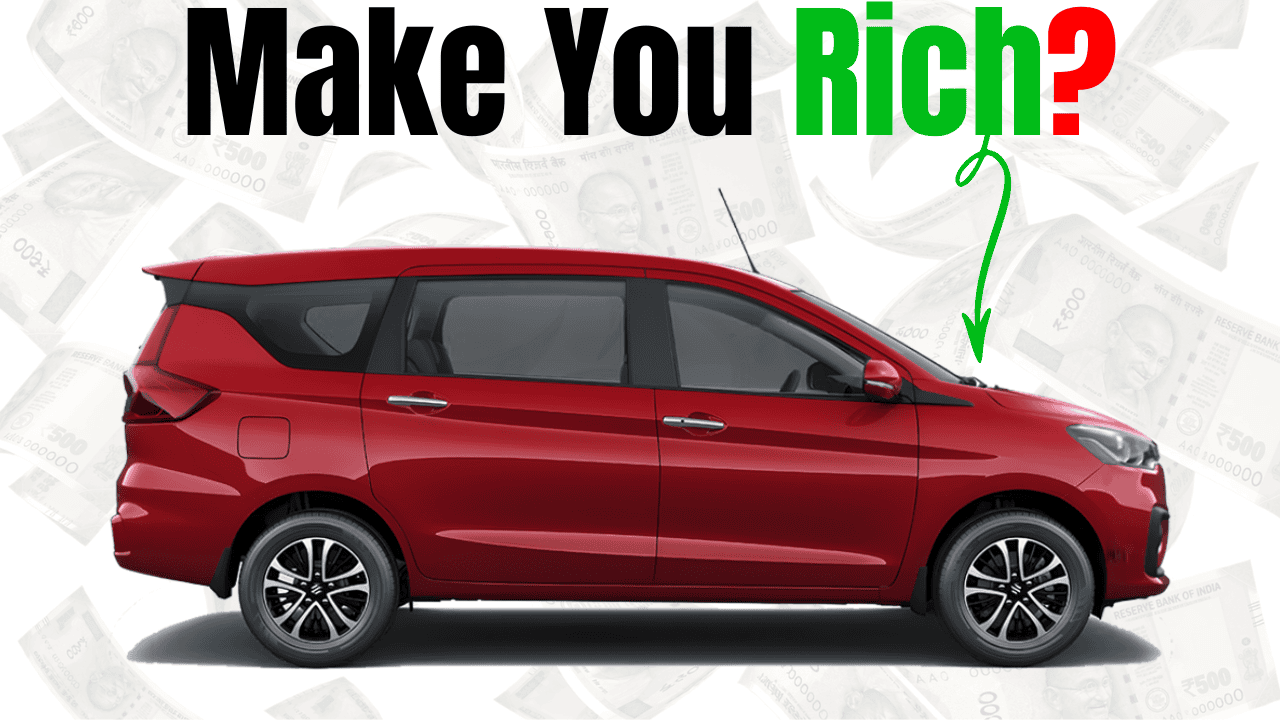
Have you heard about the claims regarding earning ₹80,000 per month from a Maruti Ertiga? The truth about these offers is that they never specify whether it is the amount of money that the taxi can book or the amount of money the driver will eventually pocket after his share and expenses. This guide explains all of them, including the workload and EMI, to give you an accurate idea of the work needed to make this type of income in your city.
Key Takeaways
- Gross revenue means fare earnings before business expenses; ₹80,000 in bookings is not ₹80,000 take-home income.
- The illustrative base case leaves approximately ₹17,250 monthly after operating allowances and EMI, before personal tax.
- Booking channels have different commissions, payment timelines and empty-return risks.
- Empty kilometres consume fuel and vehicle life without directly earning fares.
- Owner-driver earnings include payment for driving work and should not be treated entirely as investment returns.
- Cash-flow calculations deduct full EMI; profit calculations separately account for interest and depreciation.
- Local evidence should support your buying decision, including actual bookings, written quotations and transport requirements.
What Is an Ertiga Taxi Business?
An Ertiga taxi business provides paid passenger transport using a suitably registered and permitted vehicle, including the Ertiga-based Maruti Suzuki Tour M. Maruti explicitly identifies Tour M as based on the Ertiga platform — Source: Maruti Suzuki, 2024.
For clarity, every financial example below uses a Tour M CNG owner-driver model. Retail Ertiga variants and Tour M should not be treated as identical purchase quotations.
[Internal link: https://turbobehind.com/maruti-suvs-get-cheaper-after-new-gst-price/ specifications and variants]
Gross taxi revenue is the total fare income generated before deducting business expenses. Operating surplus is revenue minus operating expenses. Cash after EMI additionally deducts the full loan instalment, while economic profit recognises depreciation, financing interest and the value of the owner’s work.
Why Does Taxi Revenue Versus Profit Matter?
Taxi revenue versus profit matters because loan repayments and household spending depend on available cash, while long-term viability also depends on replacing the vehicle and rewarding labour.
For example, a ₹2.5 lakh down payment does not cover subsequent fuel purchases, unexpected repairs or unpaid customer invoices. Working capital is money available to fund those ongoing needs before customers pay.
How Can an Ertiga Taxi Generate Revenue?
An Ertiga taxi can generate revenue through app bookings, airport transfers, outstation trips and business contracts, subject to local eligibility and operating permissions.
| Booking model | Customer acquisition | Main financial checks |
|---|---|---|
| App bookings | Approved platform onboarding | Actual deductions, cancellations, settlement dates and pickup distance |
| Airport transfers | Hotels, referrals and advance bookings | Waiting, parking, delayed flights and return bookings |
| Outstation trips | Travel agents and direct enquiries | Chargeable distance, overnight costs and empty returns |
| Corporate contracts | Offices and transport contractors | Minimum billing, payment delays and replacement-car obligations |
For example, an airport transfer can look attractive until waiting time and an empty return reduce earnings per hour. Confirm the exact model’s acceptance with the relevant platform or contracting company before purchasing.
How much work is ₹80,000 revenue?
To generate ₹80,000 in gross revenue on 26 working days, you need to earn ₹3,077 per working day, before expenses.
How many paid kilometres is that?
Let’s take an example of a ₹20 fare per paid kilometre. To reach ₹80,000, you need 4,000 paid kilometres. This is an illustrative figure, not an established Delhi fare or assured customer rate.
Paid-kilometre utilisation is the proportion of total kilometres driven in which fare revenue is earned to the total distance driven. So, at the rate of 80% utilisation, 4,000 paid kilometres would equate to 5,000 total kilometres: roughly 192 kilometres to drive per working-day on average over 26 working days.
It is important to understand that these are not the only elements of a working day, since driver waiting time, cleaning, filling up the tank and customer management also require time. These assumptions can easily be tested on your actual log of trips and safe driving hours.
Consistently and for the purpose of the examples given, customer reimbursements of tolls, parking and taxes collected for remittance are excluded from the figures given in both revenue and costs. Revenue is considered before booking charges and all fares are assumed to have been collected within the month. Do not subtract platform deductions twice if calculating from a net payout to start.
What Does It Cost to Buy and Operate a Tour M CNG?
Tour M CNG ownership costs include purchase funding, commercial operating requirements, fuel, maintenance, insurance and customer-acquisition expenses.
What purchase price and EMI should you budget?
As checked on 3 October 2026, Maruti’s New Delhi page displayed ₹9,94,900 for Tour M petrol, while its FAQ listed ₹9,87,400 petrol and ₹10,83,400 CNG. These conflicting ex-showroom figures require dealer confirmation — Source: Maruti Suzuki, accessed 2026. marutisuzuki.com
Accordingly, this Delhi planning illustration assumes a ₹12.5 lakh acquisition budget, ₹2.5 lakh down payment and ₹10 lakh loan. The acquisition budget is not a dealer quotation; obtain a dated Tour M CNG breakdown covering registration, insurance, taxes and applicable fees.
For illustration, a ₹10 lakh loan at an assumed 10% annual reducing-balance interest rate over 60 months produces an EMI of approximately ₹21,247, rounded to ₹21,250 throughout this article. Processing fees and other lender charges are excluded and need separate budgeting.
What mileage and CNG cost should you use?
Maruti Suzuki lists Tour M CNG fuel efficiency at 26.54 km/kg; this manufacturer figure is not a guarantee of real-world taxi mileage. The petrol figure is 21.10 km/l, and listed seating capacity is seven persons including the driver — Source: Maruti Suzuki, accessed 2026.
For context, Business Standard reported Delhi CNG at ₹86.98/kg effective 29 August 2026, following a ₹3.89/kg increase. This is a dated reported price, not confirmation of every station’s October rate — Source: Business Standard, 2026.
For budgeting, this illustration uses ₹90/kg and 20 km/kg, producing ₹4.50 per kilometre. At 5,000 monthly kilometres, the CNG allowance becomes ₹22,500. A separate ₹1,000 petrol allowance covers starting or supplementary use; applying CNG cost to all distance makes this a slightly conservative simplification.
How Much Remains From ₹80,000 After Costs and EMI?
The illustrative Tour M CNG base case leaves ₹17,250 available after operating allowances and EMI, before personal tax and major unbudgeted expenses.
| Monthly item | Assumed amount |
|---|---|
| Gross fare revenue | ₹80,000 |
| Booking/platform charges: blended 10% | −₹8,000 |
| CNG: 5,000 km × ₹4.50 | −₹22,500 |
| Supplementary petrol allowance | −₹1,000 |
| Maintenance and tyres: ₹1 per total km | −₹5,000 |
| Insurance, permit and vehicle-tax provision | −₹3,000 |
| Cleaning, phone, unreimbursed parking/tolls | −₹2,000 |
| Total operating allowances | −₹41,500 |
| Operating surplus | ₹38,500 |
| Full EMI, rounded | −₹21,250 |
| Owner-driver cash available after provisions | ₹17,250 |
For clarity, these are planning assumptions, not operator records or market averages. The 10% booking charge is a hypothetical blended deduction, not a quoted platform commission. Actual annual bills and repairs make bank balances fluctuate around the provision-based budget.
Calculating monthly taxi cash flow involves subtracting operating cash expenses and loan repayments from cash collected during the month. Money reserved for later insurance and repairs should remain separate from spendable household income.
For an economic-profit illustration, assume ₹22,000 as the value of monthly owner labour. Depreciating a ₹12.5 lakh vehicle to an assumed ₹3.5 lakh residual value over six years gives ₹12,500 monthly depreciation. First-month loan interest is approximately ₹8,333.
Economic surplus = ₹38,500 − ₹22,000 − ₹12,500 − ₹8,333 = −₹4,333. This is before tax and any opportunity-cost charge on owner capital. Full EMI is not deducted again: principal repayment reduces debt rather than representing a profit expense.
What Changes in Weak, Base and Strong Months?
Monthly earnings change with paid distance, realised fares, empty travel and operating days, even when the vehicle’s EMI stays constant.
| Assumption or result | Weak | Base | Strong |
|---|---|---|---|
| Working days | 22 | 26 | 26 |
| Total kilometres | 3,500 | 5,000 | 6,000 |
| Paid kilometres | 2,450 | 4,000 | 5,100 |
| Paid utilisation | 70% | 80% | 85% |
| Fare per paid kilometre | ₹20 | ₹20 | ₹20 |
| Gross revenue | ₹49,000 | ₹80,000 | ₹1,02,000 |
| Operating allowances | ₹30,150 | ₹41,500 | ₹49,200 |
| Owner-driver cash after EMI | −₹2,400 | ₹17,250 | ₹31,550 |
| Cash after ₹22,000 hired-driver cost | −₹24,400 | −₹4,750 | ₹9,550 |
For consistency, every scenario uses ₹5.50 per total kilometre for CNG plus maintenance, 10% booking charges, ₹6,000 fixed allowances and ₹21,250 EMI. Hired-driver cost is an assumption; overtime, relief cover and employer obligations can increase it.
What is break-even (and can take-home reach ₹80k)?
Under the base assumptions, cash break-even is at around ₹49,000 in monthly revenue, excluding owner wages/tax. For every rupee of revenue, ₹0.55625 is contributed towards the margin after booking charges and distance-related costs, of which ₹27,250 in fixed allowances and EMI have to be met.
An example, at ₹20 per paid kilometre and 80% utilisation, each total kilometre (paid+unpaid) is earning ₹16, of which the contribution is ₹16 × 90% − ₹5.50 = ₹8.90 per total kilometre.
To reach ₹80,000 owner-driver take-home therefore implies a revenue of ₹1,93,000 or 12,051 total kilometres. Over 26 days, this implies a requirement of 463 kilometres per day of total distance (before waiting time), which is a mathematical extrapolation but not necessarily reflective of achievable workload. Costs and staffing may rise significantly.
Similarly, the loss of 5 base-case working days would reduce revenue by around ₹15,385 and contribution by approximately ₹8,558, leaving around ₹8,692 towards EMI if variable costs fall proportionately. A further ₹10,000 towards repair would make the month negative. Better margins require better pricing and utilisation, not just more driving time.
Which Tools Help You Check Ertiga Taxi Profitability?
A trip log, EMI calculator and monthly cash-flow worksheet help you replace earnings claims with measurable operating evidence.
First, use Google Sheets or free LibreOffice Calc to record paid kilometres, total kilometres, fares billed, cash received, fuel, deductions and working hours. Calculate both cash per month and earnings per hour.
What Should You Do Before Buying an Ertiga for Business?
A sound buying decision requires verified customers, written purchase terms and a budget that survives weaker demand.
- Choose your customer segment. Define routes, booking channels and payment terms.
- Collect local evidence. Review several weeks of anonymised operator logs with permission, including quiet days.
- Obtain dated quotations. Confirm vehicle variant, acquisition costs, insurance, EMI and maintenance.
- Confirm operating requirements. Check registration, applicable permits, fitness, insurance and driver eligibility with the relevant authority for your routes. Delhi’s registration guidance specifically discusses insurance-claim risks involving invalid licence, fitness or registration — Source: Delhi Transport Department, accessed 2026.
- Stress-test the budget. Include repairs, downtime, delayed invoices and household withdrawals.
- Protect reserves. Keep working capital separate from the down payment and replacement savings.
Conclusion
With an Ertiga you may build a profitable transport business, but earning ₹80,000 a month is not wealth creation nor is it a good return on investment.
In this scenario you would have about ₹17,250 left over after keeping aside the operating allowance and EMI, while hiring a driver would leave you with a deficit at the end of the month. Your results will vary depending on the fares you collect and costs you incur, besides the operating allowance there are also collections and loads to consider. Make sure to verify the bookings and calculate the surplus before purchasing the vehicle.
Written by: Sourav Ranjan, content writer covering automobiles and practical ownership topics.