
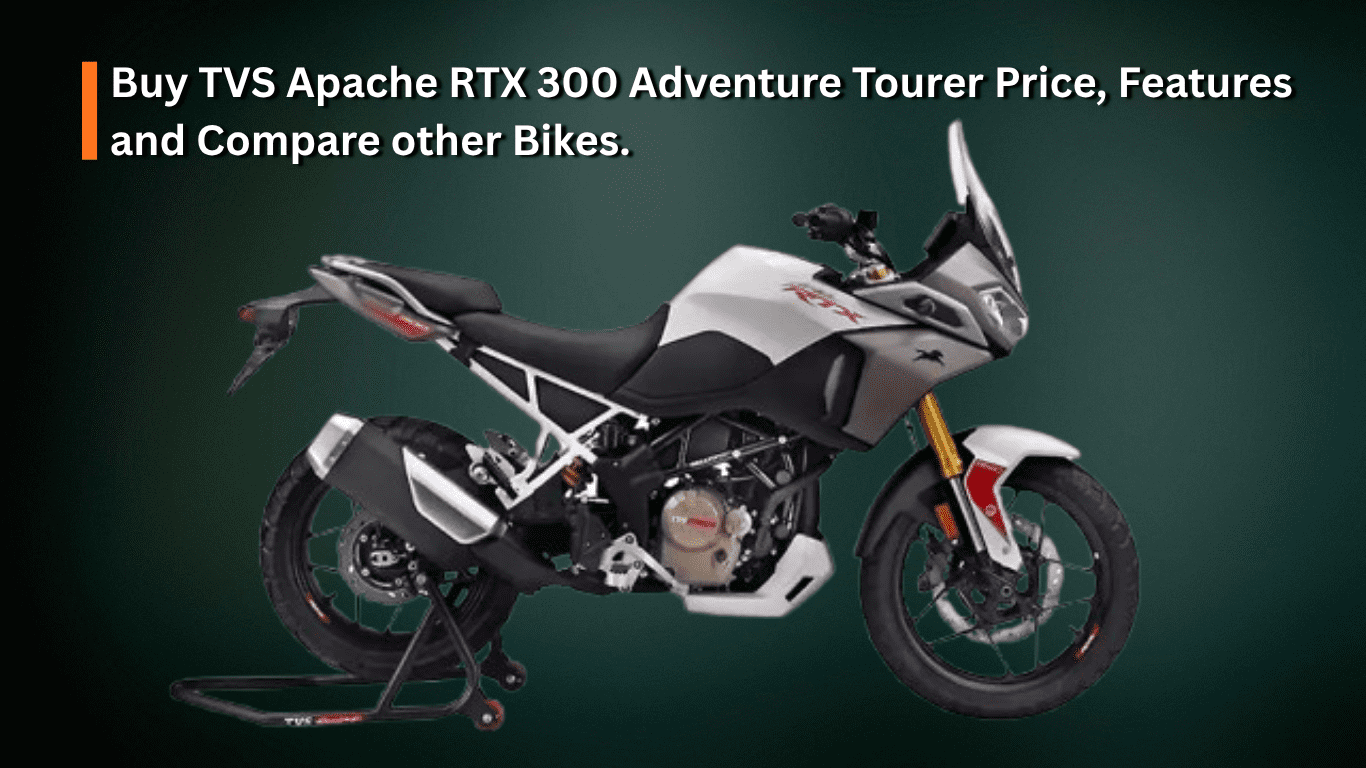
For a long time now TVS have been ruling the Indian roads with their Apache series on the entry level performance segment of the motorcycle market, but they had been missing out on the adventure touring segment. However, with the launch of the Apache RTX 300, that leaves the manufacturer with only one question to answer. Can TVS finally make their own adventure bike, or does the RTX 300 have what it takes to compete against brands like KTM, Suzuki and Yezdi?
The adventure motorcycle category is no longer a novelty in India. People are looking to buy an adventure bike that is capable of taking on rough terrain, but also has the comfort and performance to cruise on the open highway, as well as being able to serve as a daily commute. The RTX 300 is coming into a market hungry for such a motorcycle, but is the product really something that competes, or is it just TVS getting into the fray?
Table of Contents
Is the Price Truly Competitive, or Just Looks Good on Paper?
TVS has unveiled the Apache RTX 300 at Rs.1.99 lakh (ex-showroom) with the top-spec model priced at Rs.2.29 lakh. On paper, that’s a compelling set of figures, one that beats a number of its competition both in terms of specification and price. However, things aren’t quite as simple as they seem
Once you factor in insurance, registration and taxes, the on-road price soars to over Rs.2.28 lakh in Delhi for the base model and close to Rs.2.6 lakh for the top-spec variant. But is the RTX 300 really that expensive, or is TVS simply playing with numbers? Let’s take a closer look at the bike and see what it has to offer.
Does the Engine Deliver Real Performance, or Just Good Numbers?
The RTX 300 comes with a 299.1cc liquid-cooled engine that produces 36 PS and 28.5 Nm of torque. Compared to the 250cc competitors, these are fairly powerful stats. However, the true measure of a motorcycle’s performance comes not from the raw numbers stated in the specs sheet, but rather in the riding experience.
In this case, the RTX 300 appears to be all about flexibility, being less focused on the high-revving performance per se. As a result, the power is likely to be more manageable and less stressful on the rider. Coupled with the 6-speed gearbox and slipper clutch, the RTX 300 should be a forgiving machine to ride in terms of the engine management. In other words – it will feel powerful enough on the highway, but not punish the rider for overtaking in higher gears.
Can the Suspension and Chassis Handle Indian Roads?
The main characteristic of adventure motorcycles is their suspension system, which is especially complicated, as riding conditions in India are quite diverse. The RTX 300 is equipped with USD front forks and a rear mono-shock, mounted on a trellis frame. Thus, TVS wants to ensure the rider with comfort and stability on the highway, while also providing the possibility of exploring more adventurous trails. However, it is not intended for serious off-road adventures and should be considered as a travel motorcycle suitable for Indian conditions. In my opinion, this is a more realistic choice compared to an off-road motorcycle.
Are the Electronics Useful, or Just Marketing Add-Ons?
Modern motorcycles lean more and more into electronics to improve safety and comfort. The RTX 300 has features like traction control, riding modes, cruise control and a TFT display connected to the smartphone.
Cruise control is a particularly useful feature for the price, especially for long drives on the highway, but electronics usually add complexity which can make maintenance a headache down the road. We’ll have to see how well TVS does with their electronics in the long run.
Does It Actually Work as a Touring Motorcycle?
The touring motorcycle is characterized by an excellent balance between a high level of comfort and multiple high-power options. The given model RTX 300 is designed with a highly effective set of features that include an upright riding position, wide handlebars, and wind protection.
Such capabilities are critical for long-distance riding because they help avoid rider fatigue. The only possible downside is a relatively high seat height. Although the weight of the motorcycle is comfortably distributed (the whole motorcycle weighs 180 kg), it may be a challenging task for a beginner or a small rider to control the vehicle in a dense urban environment.
How Does It Compare to KTM, Suzuki, and Yezdi?
This is where the situation becomes more intriguing, as KTM has a considerable amount of off-road credibility and proven track record. Suzuki has a fantastic reliability scorecard. Yezdi has an extreme focus on rough terrain.
The RTX 300 is not a singles in any particular category, instead aiming for a well-rounded approach that delivers on more fronts than its competitors. It has more features than the Suzuki, more comfort orientation than the KTM and more street-friendliness than the Yezdi. This could very well be its strongest trait.
Is This the Right Bike for Most Indian Riders?
It depends what the rider needs. If someone is looking for extreme off-road performance, there are better options. Most Indian Riders do not spend their weekends hiking up mountains or riding through forests.
They tend to drive more on the highway or on rough roads, and sometimes on adventures. Most people who buy this motorcycle would be getting it for its versatility, rather than an extreme performance in one area.
The Bigger Question: Can TVS Be Trusted in the Adventure Segment?
While TVS has a wealth of experience in crafting well-built motorcycles, the adventure segment is a relatively unexplored territory for the company. The RTX 300 is not just another motorcycle – it is a venture into a much more challenging arena. What will define the TVS RTX 300’s success in this segment is not only the specifications but the reliability, service network, and overall experience of owning such a vehicle. Luckily, TVS has an advantage over less reputable competitors in its vast service network.
Wrapping it up
The Apache RTX 300 aims to be neither the most powerful, nor the most capable off-road or the most affordable motorcycle. It seeks to provide an acceptable level of comfort, performance, and equipment, which will suit the majority of riders. Although it is unlikely to replace the current leaders on the market, the motorcycle is a credible competitor that provides an alternative for those who are looking for a daily and touring bike.
Q 1: What is the expected on-road price of TVS Apache RTX 300 in major cities?
Answer:
The ex-showroom price starts at ₹1.99 lakh, and for the top variant goes up to ₹2.29 lakh. The on-road price in cities like Delhi, Mumbai, and Bangalore is expected to fall between ₹2.30 lakh to ₹2.55 lakh, depending on insurance, RTO charges, and accessories.
Q 2: How does the TVS Apache RTX 300 compare to the KTM 250 Adventure?
Answer:
The RTX 300 offers:
Higher power output (~36 PS vs KTM’s ~31 PS)
Better pricing
More electronics like cruise control, multiple riding modes, and traction control
However, the KTM 250 Adventure has a stronger off-road legacy and better suspension travel. For touring and features, the RTX 300 gives better value.
Q 3: Is the Apache RTX 300 suitable for long-distance touring?
Answer:
Yes. The RTX 300 is designed for touring with:
Upright riding posture
Cruise control
Windshield protection
TFT console with navigation
Strong mid-range torque
Comfortable suspension
These features make it ideal for highway rides and weekend adventures.