
Summarize this blog post with: ChatGPT | Perplexity | Claude | Grok
You probably know Royal Enfield for its thumping singles and relaxed 650cc twins. But the “750cc beast” headlines mix different motorcycles, development expectations, and a racing prototype. In this guide, we explain what the evidence supports, which details remain unknown, and whether waiting makes sense for your riding.
Last verified: 23 October 2026.
Key Takeaways
- Royal Enfield’s 750cc coverage concerns multiple projects, including Himalayan adventure and Continental GT café-racer developments.
- The Continental GT-R750 is officially identified as a race prototype, not a confirmed retail road-bike specification.
- The Continental GT 650’s 648cc parallel-twin engine provides an established comparison point. royalenfield.com
- The “biggest ever” description overlooks Royal Enfield’s historical 1140 Model KX.
- Launch predictions and estimated prices remain different from manufacturer announcements.
- A sensible upgrade depends on comfort, intended use, and total ownership cost, alongside engine performance.
What Is Royal Enfield’s Upcoming 750cc Motorcycle?
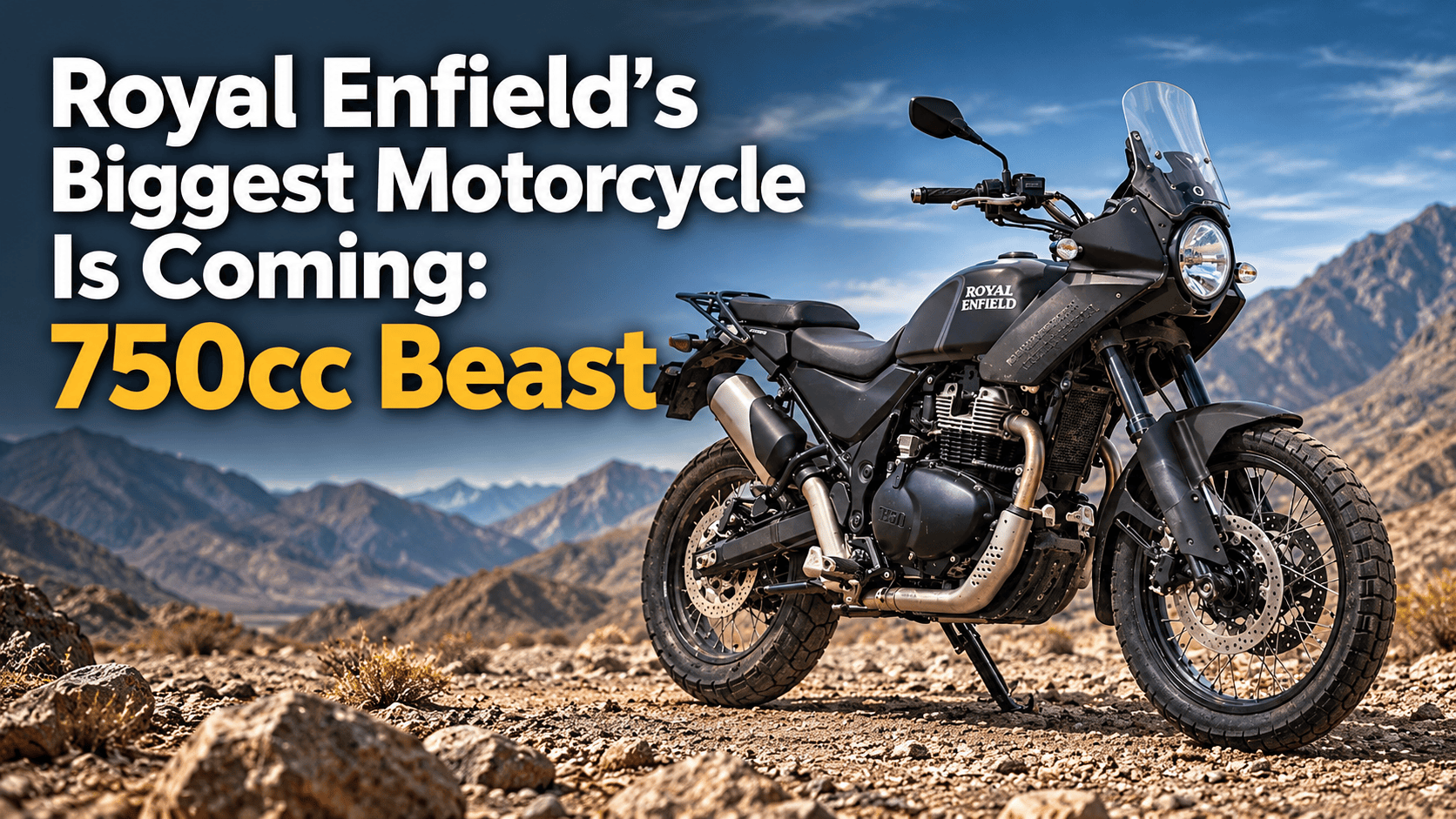
Royal Enfield’s upcoming 750cc motorcycle story concerns multiple projects: a reported Himalayan adventure motorcycle, a Continental GT café-racer development, and an officially identified GT-R750 race prototype. These names describe different applications, so photographs or specifications associated with one motorcycle should not automatically be applied to another.
For buyers, model identification comes before specification comparison. A motorcycle intended for touring with luggage presents different questions from one designed around sporty road riding.
[https://turbobehind.com/ultraviolette-x47-venom-launch-at-%e2%82%b92-65-lakh/]
Why Does Royal Enfield’s Move to 750cc Matter?
Royal Enfield’s move toward 750cc matters because it could offer riders another upgrade path beyond the existing 650cc twins.
For context, the Royal Enfield Continental GT 650 uses a 648cc parallel-twin engine, according to Royal Enfield’s Indian product page. Its detailed specification table lists 34.9 kW, 52.3 Nm, and a six-speed gearbox.
In simple terms, displacement describes the volume swept by the engine’s pistons, while a parallel twin places two cylinders beside each other. The current GT’s 648cc engine provides a concrete example of both terms.
However, a larger engine does not establish better acceleration or comfort by itself. A heavier motorcycle with taller gearing could feel less urgent than its engine capacity suggests.
[https://turbobehind.com/kawasaki-z300-revealed-in-india-bookings-start/]
Is the Royal Enfield 750 Really the Brand’s Biggest Motorcycle?
The Royal Enfield 750 should not be described as the brand’s biggest-ever motorcycle without qualification.
Historically, Royal Enfield’s archive includes an arrangement drawing of the 1140 Model KX dated 1935.
For this article, the relevant comparison is engine capacity above the modern 648cc twins. Physical dimensions, kerb weight, and maximum power are separate measurements; a larger-capacity engine does not prove that its motorcycle leads in every category.
How Do the Himalayan 750 and Continental GT 750 Differ?
The Himalayan 750 and Continental GT 750 represent different reported riding priorities: adventure touring and café-racer road riding.
What Is the Royal Enfield Himalayan 750?
The Royal Enfield Himalayan 750 is the adventure-touring model being worked on for the current development cycle. BikeWale reported its appearance at Himalayan Base Camp in Leh on 7 September 2026.
For potential owners, the real-world performance of the completed machine is of key interest. An upright seating position, adequate wind protection, and versatile luggage options may be more important to a touring rider than high power output figures.
For instance, a rider carrying a pillion passenger will want to know the maximum load capacity, rear suspension preload settings, and passenger seat comfort. A solo adventurer riding on rough terrain will have different requirements to a commuter riding on predictable roads, but will need to pay close attention to the bike’s low-speed stability, suspension response, and footpeg placement.
That said, adventure bike aesthetics are no substitute for genuine off-road credentials. The production Himalayan’s actual weight, tyres, ground clearance, and protective features will define its capabilities far better than its looks.
What Is the Royal Enfield Continental GT 750?
The Royal Enfield Continental GT 750 is the café-racer model that Autocar India road-tested. They continued to road-test the Continental GT 750, as reported on 10 September 2026, and spoke of its EICMA 2026 debut being expected.
For the would-be owner of such an exciting machine, there is more to the café racer than meets the eye. It may look good, but you will need to consider how the riding position affects you, personally. For example, the handlebars may be great for carving up the open road, but will they put a strain on your wrists when you are using your scooter on a slow commute? Consider the seat shape, the bend of your knees and how it feels to steer.
Existing GT owners must consider which upgrades they would value most. There’s nothing wrong with wanting more power, but can you imagine using the extra poke on the road? You may also want more wind protection or better dashboard displays, so it’s all a matter of personal preference.
Is the Continental GT-R750 a Race Prototype or a Road Bike?
The Continental GT-R750 is a Royal Enfield race prototype that appears on the manufacturer’s Continental GT Cup 2026 web page. Royal Enfield specifies its race-oriented suspension, brakes, tyres, exhausts, and rider-position components.
To readers, a race prototype implies that the motorcycle has a racing brief. Rather than comfort or even specifications, the engine’s performance and the equipment’s ability to withstand the strain of circuits matter. By default, components designed for such use cannot define the criteria for production models, for which comfort and price are likely to be more important.
For instance, the equipment might sacrifice the rider’s comfort for the greater cause of adhesion and motion. A similar name does not erase the discrepancies between what a prototype and production model can offer.
Which Royal Enfield 750 Specifications Are Officially Confirmed?
A complete production specification sheet for the Himalayan 750 or Continental GT 750 was not established by the official material reviewed for this article.
For clarity, confirmed means manufacturer-supported; reported means attributed to a publication; observed describes development-bike hardware; and unknown identifies unresolved production information.
| Item | Model | Current information | Evidence status | Source/date |
|---|---|---|---|---|
| Engine capacity | Himalayan / GT | Approximately 750cc discussed; exact production displacement unresolved | Reported | BikeWale, 7 Sep; Autocar, 10 Sep 2026 |
| Configuration | Himalayan / GT | Parallel twin discussed | Reported | Same reports |
| Cooling | Both road projects | Not confirmed for production in reviewed official material | Unknown | Checked 23 Oct 2026 |
| Power and torque | Both road projects | Final production outputs not established | Unknown | Checked 23 Oct 2026 |
| Gearbox | Both road projects | Final specification not established | Unknown | Checked 23 Oct 2026 |
| Brakes | GT test bike | Twin front discs described | Observed, via reporting | Autocar, 10 Sep 2026 |
| Suspension | GT test bike | Conventional fork and twin rear shocks described | Observed, via reporting | Autocar, 10 Sep 2026 |
| Electronics | Both road projects | Final production feature lists unresolved | Unknown | Checked 23 Oct 2026 |
| Wheels | GT test bike | Alloy wheels described; retail choices unresolved | Observed, via reporting | Autocar, 10 Sep 2026 |
| Seat height and kerb weight | Both road projects | Not confirmed for production | Unknown | Checked 23 Oct 2026 |
| Racing equipment | GT-R750 | Track-focused components described officially | Confirmed for race prototype | Royal Enfield GT Cup, accessed 23 Oct 2026 |
In practical terms, torque describes twisting force, while power describes the rate of doing work. For overtaking, the useful result depends on engine delivery, gearing, load, and available speed—not one isolated number.
When Will Royal Enfield Launch Its 750cc Motorcycles in India?
A confirmed India launch, booking opening, and delivery schedule was not established in the official sources reviewed as of 23 October 2026.
| Date or milestone | Development | How to interpret it |
|---|---|---|
| 7 September 2026 | BikeWale reported Himalayan showcase | Reported public appearance |
| 10 September 2026 | Autocar reported GT testing | Development update |
| EICMA 2026 | Debut discussed in reporting | Expected unveiling, not guaranteed retail availability |
| India launch | Final announcement awaited in reviewed material | Separate from global unveiling |
| Bookings and deliveries | Verified terms not established | Await written manufacturer/dealer information |
For pricing, BikeWale’s upcoming-model listings showed ₹4 lakh onwards for the Himalayan 750 and ₹3.80 lakh onwards for the Continental GT 750, both labelled expected.
Should You Buy a Royal Enfield 650 Now or Wait for a 750?
Buying a Royal Enfield 650 now suits riders whose needs are met by an available motorcycle; waiting suits riders who can postpone purchase until the 750’s specifications and riding experience are clearer.
For comparison, the Continental GT 650 is an existing road-going café racer, while the upcoming 750 projects involve unresolved production details. Neither category should be judged solely by its displacement badge.
| Dimension | Existing 650 option | Upcoming 750 option |
|---|---|---|
| Availability | Dealer stock and test rides can be checked | Launch and allocation require confirmation |
| Intended use | Choose an established model matching your riding | Himalayan and GT projects target different uses |
| Performance | Published figures and testable behaviour | Final outputs and road behaviour unresolved |
| Equipment | Inspect the actual variant | Prototype hardware may change |
| Ownership cost | Obtain current insurance and service quotations | Model-specific costs remain uncertain |
For perspective, Royal Enfield’s detailed GT 650 table lists an 804mm seat height and 214kg kerb weight.
How Can You Budget for and Test a Royal Enfield 750?
A useful buying assessment combines a purchase worksheet, ownership-cost estimate, and test ride matched to your daily use.
First, calculate your initial budget:
| Budget item | What to enter |
|---|---|
| Motorcycle | Written variant-specific ex-showroom quotation |
| Registration and taxes | Applicable local charges |
| Insurance | Quotation with coverage and exclusions |
| Riding gear | Helmet, gloves, jacket, trousers, boots |
| Accessories | Only equipment needed for your riding |
| Finance charges | Processing fees and other applicable costs |
Next, calculate running costs using:
Annual fuel cost = annual kilometres ÷ assumed km/l × petrol price.
For example, assume 8,000km annually, 25km/l, and ₹105/litre. Fuel would cost ₹33,600 annually. Adding hypothetical servicing of ₹6,000, insurance renewal of ₹8,000, and a ₹5,000 wear-item reserve produces ₹52,600 annually, excluding depreciation and finance. These are worksheet assumptions, not Royal Enfield 750 forecasts.
For a multi-year comparison, use purchase and acquisition costs + running costs + finance interest − resale proceeds. Avoid adding loan principal again when the purchase price is already included.
For calculation, a free spreadsheet or phone calculator is sufficient. Change the mileage assumption to see whether your budget remains comfortable.
For your test ride, check:
- Low-speed control: U-turns, parking, and stop-start balance.
- Heat: Comfort during ordinary traffic conditions.
- Ergonomics: Wrist pressure, knee bend, and foot placement.
- Braking: Predictable response during normal, safe stops.
- Pillion comfort: Seat space, access, and suspension response.
- Touring fit: Wind exposure and approved luggage arrangements.
For different buyers, the unresolved priorities change:
| Rider | Most important questions |
|---|---|
| Daily commuter | Is the weight manageable? How comfortable is traffic riding? |
| Weekend café-racer enthusiast | Does the riding position remain comfortable beyond a short ride? |
| Long-distance touring rider | What are the payload, range, luggage options, and service requirements? |
What Should Buyers Check Before Booking a Royal Enfield 750?
Buyers should verify the exact model, final specification, full price, and written booking conditions before paying.
- Check the official announcement for the production model and variant.
- Request an itemised quotation covering registration, insurance, and accessories.
- Read booking terms covering cancellation, refunds, and allocation.
- Confirm warranty and servicing requirements for the actual motorcycle.
- Arrange a test ride before committing where possible.
- Revisit the comparison when final specifications and independent road tests appear.
For reference, evaluating an upcoming motorcycle involves separating official specifications, reported developments, prototype observations, and information that remains unknown.
Conclusion
The Royal Enfield 750cc motorcycle story offers an interesting potential upgrade, but the right choice depends on the finished motorcycle and your riding needs.
For your decision, compare comfort, usability, and total cost alongside performance. Let the launch excitement start your research; let the test ride guide your purchase.
Written by: Sourav Ranjan, content writer.